MMA Moneyline Odds: Reading the Two-Way Fight Market
 Available in US
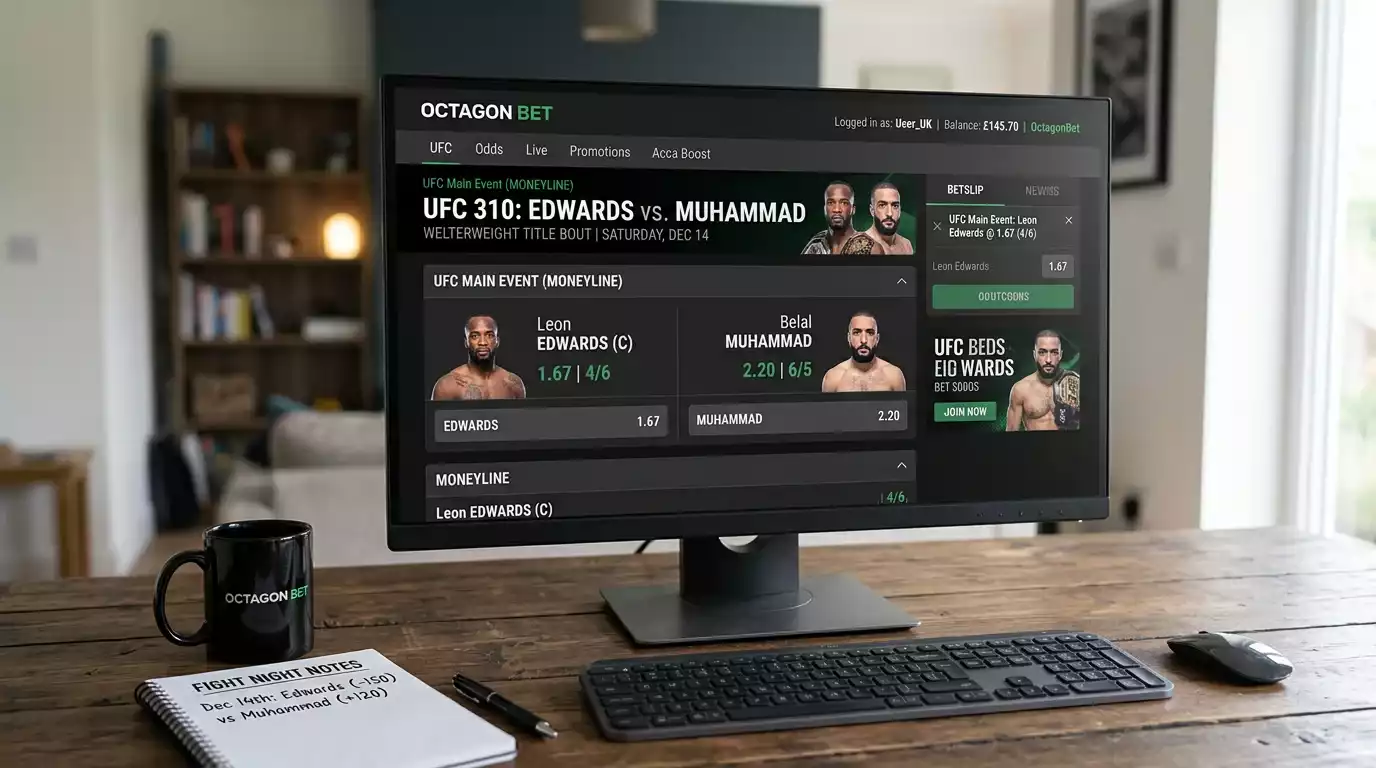
Of every market on a UFC card, the moneyline is the one I respect most. It is the cleanest expression of what the betting public, the sharps, and the operator collectively believe about who is going to win. No method bucket, no round window, no prop quirk — just a binary price that the cage settles in fifteen or twenty-five minutes.
I have watched casual punters chase round bets, method props and bet builders looking for the magic price. I have also watched serious bettors quietly grind profit by doing nothing more than identifying mispriced moneylines two or three times a card. The discipline of staying on the simplest market is harder than it looks and more profitable than most people credit.
Convert moneyline odds using our MMA odds formats and value guide.
How a Moneyline Is Priced
A moneyline starts with the bookmaker’s internal estimate of the true probability that each fighter wins. Call those estimates p(A) and p(B). They must sum to one, since draws and no-contests are statistically rare enough to be priced separately or absorbed into the void rules.
The book then converts those probabilities into raw fair prices — one divided by the probability — and inflates each side by the margin it wants to extract. On UFC main events at a sharp UK book, the round-trip margin sits close to four per cent. On a Fight Night prelim it widens to six or seven. On a less competitive operator it can hit ten or higher.
Take a fight the book genuinely sees as 65/35. The fair prices are decimal 1.54 and 2.86. After a four per cent margin, the displayed prices land near decimal 1.48 and 2.75, fractional 8/17 and 7/4. That four per cent gap between fair and offered is the operator’s overround, and on the moneyline it is the cleanest place to measure it.
Why is the moneyline the cleanest place? Because there are only two outcomes. Every other market has at least three — over, under or push; KO, submission or decision; rounds one, two, three, four, five or distance. Each extra outcome lets the operator hide margin across more legs. On the moneyline there is nowhere to hide, which is exactly why sharper operators sit four per cent and weaker ones sit ten. You can measure them against each other on this one market more reliably than on any other.
That four per cent figure is not an abstraction. The sharper UK books — the ones the regulator’s published account-restriction data places on the receiving end of more closures by commercial categorisation — quote UFC main-event moneylines in that tight band consistently. The four per cent figure they’re known for on the bigger PPV cards is the public-facing version of an internal model that’s tighter still.
Favourite Price Bands and Win Rates
The empirical pattern that surprised me when I first ran the numbers, and still surprises punters I show it to, is the win rate of UFC favourites across different price bands.
Sample the OddsTrader data on UFC bouts from 2013 onward. Favourites priced between minus 400 and minus 900 — decimal 1.11 to 1.25, fractional 1/9 to 1/4 — win between eighty-eight and ninety-three per cent of their fights. That is not a typo. The market gets these heavy favourites broadly right.
Drop into the band between minus 122 and even — decimal 1.83 to 2.00, fractional 5/6 to evens — and the win rate collapses to roughly fifty-one per cent. The “slight favourites” are essentially coin flips. The label “favourite” disguises a category that includes both near-certainties and near-toss-ups, and the difference between them is not a small adjustment to the same edge — it is a structural change in how the market is performing.
The practical takeaway is uncomfortable. Heavy UFC favourites at minus 400 and steeper are reliable, but the moneyline price is so low that you need a flawless win rate to grind profit, and even small mispricings cost more than they pay. Slight favourites in the minus 122 to even band are the most reliably mispriced segment of the moneyline market — sometimes the public moves the line wrong, sometimes the model lags style mismatches — but the variance is fierce.
I have built half my UFC moneyline portfolio around the slight-favourite band, taking lines I judge to be three or four points off true, and the other half around carefully chosen underdogs. The heavy favourite band I largely ignore, partly because the operator commercial restrictions on accounts that pick winners consistently — the regulator records that over four per cent of UK accounts have been restricted on commercial grounds, many of them on accounts in profit — make life difficult for anyone who tries to grind that band over time.
Where Underdog Moneylines Land
From April 2013 to November 2022, OddsTrader’s UFC database recorded 1,462 fighter wins as underdogs. That is not a small number. Spread across roughly a decade of UFC cards, it represents the live, paying-out evidence that the market overprices favourites systematically enough for underdog backing to remain a viable category.
The pattern inside that 1,462 is the more interesting part. The mispricings cluster in a few recognisable structures. Late replacements on under ten days’ notice — where lines have not had time to absorb the full implications of style mismatch and conditioning gap — produce positive return on investment when the price clears the favourite line, particularly in round one. Stylistic counters that the public undersells — a wrestler against a hittable striker, a southpaw against an orthodox opponent who has struggled with stance, a switch-stance specialist who pulls win rates near fifty-seven per cent across the dataset — show up disproportionately in the underdog winner column.
The mistake is treating “underdog” as a single category. A plus-110 underdog at decimal 2.10 against a fighter you have a real read on is a different bet from a plus-450 underdog at decimal 5.50 hoping a counter lands. The first is a value pick on a 48 per cent fighter mispriced as a 45 per cent one. The second is a lottery ticket that needs precision in timing and venue context to be anything other than gambling.
For the question of when an underdog is worth backing because the favourite is genuinely overpriced, the deeper read is in the walkthrough on fight and round handicap markets, which explains how the same dynamic plays out across the spread variants.
Converting a Moneyline to Probability
This is the one piece of arithmetic every UK punter should be able to do in their head. It separates people who price their bets from people who guess them.
For decimal odds, implied probability equals one divided by the decimal price. A 1.50 favourite implies 0.667, or 66.7 per cent. A 2.75 underdog implies 0.364, or 36.4 per cent. Add them: 103.1 per cent. The 3.1 per cent above one hundred is the bookmaker’s margin. That is the four-per-cent-ish overround discussed earlier, expressed numerically.
For fractional odds, the formula is denominator divided by the sum of numerator and denominator. 7/4 implies four divided by eleven, or 36.4 per cent. 8/17 implies seventeen divided by twenty-five, or 68 per cent.
Now the harder skill: stripping out the margin to get the bookmaker’s true probability estimate. Divide each side’s implied probability by the total. For our 66.7 / 36.4 example, the book’s true estimates are 64.7 per cent and 35.3 per cent. Those are the numbers you should be comparing your own assessment against, not the raw implieds. If you think the favourite is a 70 per cent shot and the book is pricing 64.7 per cent under the margin, you have an edge worth staking. If you think the favourite is a 65 per cent shot and the book is pricing 64.7 per cent under the margin, you do not — and the four per cent margin will eat you alive over time.
That is the entire arithmetic of moneyline value. Implied minus margin, compared against your own probability estimate. Everything else — handicaps, methods, rounds, props — is built on top of this conversion, and people who skip the conversion struggle with all of them.
Visit betting mma for MMA betting fundamentals.
Why I Keep Coming Back to This Market
The moneyline rewards depth of read and punishes superficial bias. Every other market on the card sells you a more exciting story — round three KO, underdog submission, fight ends inside eight minutes — and prices that story behind a wider margin. The moneyline charges you the lowest commission in the building because it offers the fewest hiding places for the operator.
If I had to give up every other UFC market and keep only one, this would be it. Not because it is the most fun. Because it is the most honest. The price, the probability and the outcome are the same shape, and the gap between your number and the operator’s number is the only thing that matters.
Why are some UFC moneylines symmetric on either side of even money?
Symmetric moneylines around evens — both fighters priced at decimal 1.91 or thereabouts — happen when the operator’s true probability estimate is genuinely close to fifty-fifty and the displayed prices simply add the margin equally on both sides. These bouts are the toss-ups the book has no read on either, and the empirical win rate for slight favourites in this band sits near fifty-one per cent across historical UFC samples. Treat symmetric prices as a signal that any edge has to come from your own model, not from the market’s lean.
Does a UFC moneyline include the possibility of a draw?
No. The two-way moneyline pays only on a clear winner. If the official result is a draw — split or majority — the moneyline market is voided and stakes are returned. Some operators offer a separate three-way fight result market that prices the draw explicitly. The implied probability sums you do on a two-way moneyline therefore exclude draw outcomes, which is one reason the two prices typically add to slightly above one hundred per cent after margin rather than well above it.
Published by the Betting mma team.