MMA Betting in the UK: A Data-Led Guide to Markets, Odds and Integrity 2026
 Available in US
Table of Contents
- What a UK MMA Bettor Should Walk Away Knowing
- UK Betting Market in Numbers: Where MMA Fits
- UKGC Framework: Licensing, Affordability and 2025–2026 Reform
- UK-Licensed Operators Covering MMA Markets
- Core MMA Betting Markets Explained
- UFC Method Ladder Calculator
- Fractional, Decimal and Implied Probability
- Live Streaming and In-Play Wagering on UFC Cards
- UK Fighters Driving the 2026 Card Calendar
- Integrity in MMA Betting: IBIA, IC360 and Recent Cases
- A Data-Led Approach to Value
- Responsible Gambling: Tools and 2025 Affordability Rules
- Pre-Bet Checklist Before You Stake on a UFC Card
- Frequently Asked Questions

A nine-year analyst’s framework for British punters who already know what a TKO is — and want the data, regulation and integrity layers that the rated guides keep skipping.
By UK MMA Betting Analyst · Fight-card breakdowns, value-line modelling, UKGC compliance
I have spent nine years building fight-card models for UK-licensed sportsbooks, and the last twelve months have been the most disorienting stretch I can remember. Not because the maths changed — the closing line is still the closing line — but because the ground underneath every UFC bet shifted at the same time. The UK Gambling Commission dropped the light-touch affordability threshold to £150 a month in February. A featherweight named Isaac Dulgarian had his bout pulled the night before because the line moved in a way that did not match the form. The UFC 324 main card lost Johnson against Hernandez before it ever reached the cage, with Dana White on a podcast snapping “I’m not doing this s*** again” and walking away. And the O2 Arena packed in 18,629 punters for Evloev against Murphy with a gate over £3.5 million.
None of the rated MMA-betting guides I survey for benchmarking caught any of that. They are still listing welcome bonuses and explaining what “moneyline” means. The deeper questions — how a £150 trigger reshapes your deposit pattern, what an IBIA alert actually does to your stake, whether the +1.5 significant-strike differential is still a usable filter — were missing. This pillar is my attempt to fix that, written for a British punter who already knows what a TKO is and wants the rest.
What a UK MMA Bettor Should Walk Away Knowing
- UK sports betting generates about £2.48 billion in annual gross gambling yield; MMA sits inside that pool without its own breakout, but 48% of adults gamble in some form and UFC ranks second-most-followed in Britain after football audiences.
- From 28 February 2025 the UKGC light-touch financial check triggers at £150 a month, and from 31 October 2025 every operator must prompt you to set a financial limit before your first deposit.
- IBIA logged 300 suspicious betting alerts in 2025 — a 29% jump on 2024 — and a single MMA athlete was sanctioned; the Dulgarian withdrawal and the UFC 324 pulldown both came from this monitoring pipeline.
- Heavy UFC favourites priced -400 to -900 cash 88–93% of the time, while 1,462 underdogs won between April 2013 and November 2022, which is why a layered strategy beats a single-tip approach.
UK Betting Market in Numbers: Where MMA Fits
The first thing a new analyst on my desk learns is that the UK Gambling Commission does not break MMA out as its own line in any quarterly report. You cannot phone someone up and ask for the UFC slice. What you can do is triangulate, and the picture that emerges is more interesting than the bookmaker marketing would suggest.

Start with the headline. The UK industry produced £11.5 billion in gross gambling yield across April 2023 to March 2024, excluding lotteries, and that figure climbed to £16.8 billion when the Commission reported across the following year ending March 2025. Sports betting specifically generates around £2.48 billion in annual GGY heading into 2026, with online activity continuing to run the show. Online GGY hit £1.45 billion in the first quarter of 2025 alone, up 7% year on year, and online real-event betting added a further £596 million in the previous quarter, up 5%. Monthly active accounts on online platforms averaged 13.5 million in Q1 2025, a 2% bump.
£2.48 bn
UK sports betting annual GGY heading into 2026
£1.45 bn
Online GGY in Q1 2025 alone, up 7% year on year
13.5 m
Average monthly active online accounts in Q1 2025
48%
Share of UK adults gambling in some form
Andrew Rhodes, the Commission’s chief executive, framed the structure plainly when he opened his IAGR keynote in October 2025: “Participation is stable at around 48 per cent of the adult population… The whole GB market is valued at about £15.6 billion and £11.5 billion of that is the size of the market once we exclude lotteries. Remote gambling, which is almost all online, will be £6.9 billion in terms of the market.” That puts roughly 22.5 million British adults inside the gambling ecosystem in any given month.
Where does MMA actually land inside this? Football alone takes around £1.1 billion of UK sports-betting GGY, which means MMA — even with UFC pay-per-views, Cage Warriors developmentals, and the Bellator/PFL/KSW spillover — sits in a much smaller bucket. There is no published number that splits combat sports out. What we have instead is corroborating evidence: UFC sits second only to football audiences in Britain, the O2 Arena consistently sells out, and the Commission’s most recent figures show 8% of UK adults placed an online sports or racing bet in the last four weeks of Wave 3 (July–October 2025). That last figure breaks down sharply by gender — 16% of men against 4% of women place a sports bet in any rolling four-week window — and skews heavily mobile-first.
95% of UK online gambling now happens from inside the home, and in the 18–24 bracket, 76% of all sessions begin on a smartphone. Fight-night markets in the UK are essentially a mobile-first economy with desktop as the back-up screen.
The data point I lean on most for market sizing is this: the projection that UK sports betting will grow to roughly £16.8 billion by 2030 at an 11.4% compound annual rate. MMA may not be broken out, but the rising tide is real, and the operators who price UFC well will keep gaining share inside it.
UKGC Framework: Licensing, Affordability and 2025–2026 Reform
I remember the morning of 28 February 2025 because three different colleagues forwarded me the same UKGC bulletin before 9am. The financial check threshold had dropped from £500 a month to £150 a month, and our compliance officer wanted to know how it would change deposit patterns on a Saturday UFC card. The honest answer was: more than the operators were admitting, less than the punters feared.

The UK Gambling Commission licenses every sportsbook that can lawfully accept your stake on a UFC fight. If the brand’s footer does not show a UKGC account number, the operator is not regulated for the UK market, and you have no consumer recourse if anything goes sideways. That is the floor. Above the floor sits a reform programme that has been running at unusual pace through 2025 and into 2026, and three pieces of it touch the MMA bettor directly.
The three rules that reshape a 2026 UFC deposit
First, the light-touch financial vulnerability check dropped to £150 in a rolling month from 28 February 2025. Second, from 31 October 2025 every operator must ask you to set a financial limit before your first deposit and remind you to review it every six months. Third, the statutory levy on gambling operators came into force on 6 April 2025, with the first payments due 1 October 2025, which is what funds the new research-and-treatment system.
The £150 check is frictionless on the user’s side most of the time. The operator runs an open-banking lookup or a credit-reference data sweep, and unless something flags, you do not see anything. Where it bites is when a punter wants to load £200 across a single PPV weekend after a quiet month — the operator now has to confirm that level of spend is consistent with the financial picture before allowing the deposit to settle. The Commission also runs harder, more visible affordability checks above the £150 threshold for higher stakes.
The October 2025 limit-prompt rule is the one that changes behaviour the most. Every new account has to be offered a deposit, loss, or session limit before the first stake. If you keep tapping “remind me later”, you will see that prompt again at six-month intervals for the life of the account. Operators have to display the limit you set on every deposit screen, and the limit you set carries across every market — UFC, football, racing, esports.
What does enforcement actually look like in practice? Rhodes was explicit in his IAGR keynote. “Year on year we saw a 300 per cent increase in the number of criminal cases we were taking as a regulator.” And later, on the matter of unlicensed operators: “There is nothing more exploitative than the illegal market.” The Commission’s illegal-gambling unit reported around 200,000 URL removal requests to search engines across the financial year and continues to track traffic across more than 1,000 illicit sites.
The data Rhodes shared on operator behaviour at the same conference deserves attention. Across the year, 4.31% of UK accounts had been restricted by sportsbooks “for commercial reasons” — many of those accounts belonging to customers who were ahead. That figure is one of the few public data points on how much “winning player” friction actually sits inside the licensed market. On the other side, the same data showed 96.3% of withdrawals between June and September 2024 were processed automatically, 3.5% within 24 hours, and only 0.1% taking longer than 48 hours. Operators are paying out fast; they are also closing winning accounts fast.
If you are setting up a new UK account for the 2026 UFC calendar, decide your monthly deposit ceiling before you tap “skip” on the limit prompt. The number you set will follow you across every fight night, and it is the single most useful guardrail the new framework gives you.
UK-Licensed Operators Covering MMA Markets
One of the questions I get most often from people new to UFC wagering is “which book should I use?” That is the wrong question to start with. The right question is: what does the operator landscape actually look like, and where do the differences sit when you strip away the front-page promotional layer?
The UK MMA betting space sits across roughly four operator archetypes. There are the long-form sports specialists that grew up around football and racing and have extended into combat sports as a depth play. There are the digital-native operators built mobile-first from the start. There are the licensed UK arms of international groups operating across multiple jurisdictions. And there is a smaller tier of streaming-focused books for whom in-play UFC video is a primary acquisition lever. Each archetype prices and structures MMA markets a little differently.
Margin depth
Top-tier UK operators tend to price two-way UFC moneylines at 4–6% overround on headline bouts, widening to 7–10% on prop and exact-round markets. Thinner cards see margin widen another two percentage points.
Streaming attachment
Only a handful of UK-licensed books carry UFC live video, and never as a blanket guarantee — coverage is fight-by-fight, sometimes geo-restricted, and usually requires a funded balance or qualifying stake.
Bet Builder depth
Books with deep proprietary trading desks open more correlated legs on the same fight: method, round, distance, takedown counts. Newer entrants restrict combinations or block them entirely.
Withdrawal speed
The UKGC’s data shows 96.3% of UK withdrawals are automated and 3.5% complete within 24 hours, but operator variance still exists — some books default to 1–2 working days even when funds clear instantly at others.
Picking which archetype suits you depends entirely on what you bet. If your strategy concentrates on early-round prop markets — significant strike totals, takedown counts — you want a desk with a high-tolerance trader and deep prop coverage, even if the front-page promo is weaker. If you are a moneyline-and-method punter, margin is everything and the welcome offer is secondary. If you want to watch the prelims while you trade, you need to verify streaming coverage on the specific card before depositing.
The bigger structural piece to know about is account restriction. The UKGC data I cited earlier is worth restating because it cuts through the marketing: 4.31% of UK accounts get restricted on commercial grounds inside a single year, with a meaningful share of those restrictions hitting winning bettors. Rhodes warned operators in his CEO Briefing in November 2025 that “there will be no warnings” on regulatory breaches, but that does not stop bookmakers from quietly throttling profitable customers. A serious MMA bettor in the UK runs two or three accounts deliberately, not for arbitrage reasons but for resilience.
If you want the deeper operator audit — methodology, withdrawal-time analysis, mobile app reliability, the use-case shortlists I cannot reproduce here without stepping into ratings territory — I have built that out in the dedicated operator-audit piece. The pillar’s job is to set the framework. The cluster does the comparative legwork.
The point I keep returning to: there is no single “best” UK MMA sportsbook because there is no single MMA bettor. The operator that maximises one punter’s edge will be hostile to another’s. The framework matters more than the brand.
Core MMA Betting Markets Explained
UFC Method Ladder Calculator
The three method prices – KO, submission, decision – should reconcile back to the moneyline. When they don’t, the gap is where the value hides. Enter a fighter’s four prices and the calculator strips the vig and shows the mismatch.
How this works: every price converts to an implied probability – American negative |odds| ÷ (|odds| + 100), positive 100 ÷ (odds + 100), or decimal 1 ÷ price. The moneyline is the fighter’s chance to win by any method. The three method prices (KO/TKO, submission, decision) are the same win broken into how it happens, so their implied probabilities should sum to the moneyline’s – both describe the identical event. Because each price carries the operator’s margin, the method sum runs above the moneyline: that surplus is the method-market overround, always fatter than the two-way moneyline cut. To read the true split, the calculator de-vigs the three buckets – each divided by their sum – so they rescale to 100% and you see the market’s honest KO-vs-sub-vs-decision probabilities. The value shows up in the gap: when your own read of how the fight ends diverges from the de-vigged split – you expect a KO where the market leans decision – the method line pays you for a view the moneyline can’t express. This tool reconciles prices; it does not know the fighters, so pair it with the tape, stance, and significant-strike differential before you stake. Not financial advice. 18+ – GamStop and BeGambleAware are protection routes; National Gambling Helpline 0808 8020 133.
The first UFC card I traded professionally was on TUF Finale night in 2017. I had built a model that priced fights only on the moneyline, ignored everything else, and lost slowly across a six-card run. The problem was not the model — the model was fine. The problem was that I had been pricing only one market when the card actually offered fifteen, and the value was sitting in the markets I had not touched. UFC markets in 2026 have more depth than ever, and the overround is genuinely thinner on the popular ones.

Moneyline — the simplest fight market, two-way head-to-head pricing on who wins, draws settle as a stake refund or void depending on the operator.
Method of Victory — predicts how the fight ends: KO/TKO, submission, or decision. Three-way market, occasionally split further into KO-by-strikes vs corner-stoppage.
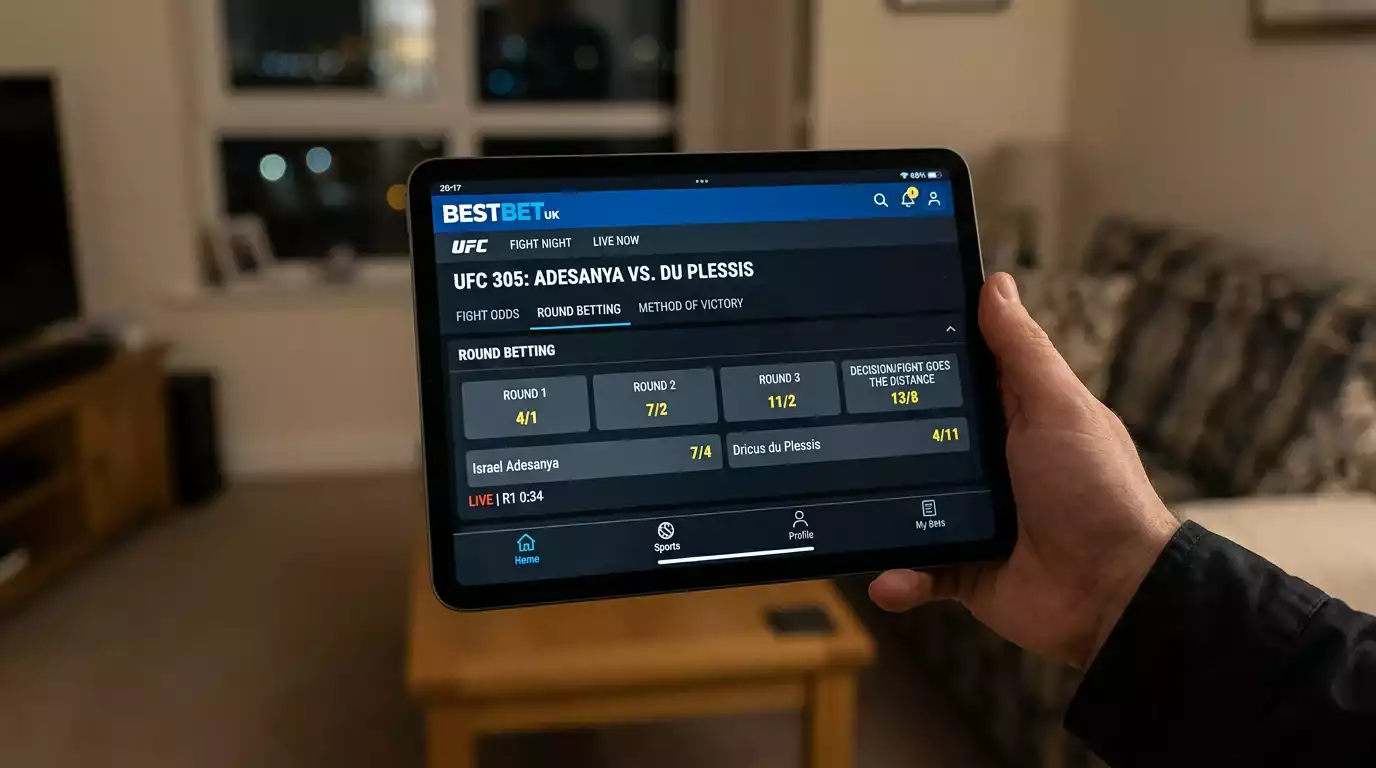
Round Betting — picks the exact round in which the fight ends, with separate selections for “fight goes the distance”.
Over/Under Rounds — the total-rounds market, priced on 1.5, 2.5 and 4.5 round lines. Over-under settles on time within the round, not full-round completion.
Prop Bets — statistical markets settled on official UFC fight metrics: significant strike totals, takedown counts, control-time minutes.
Bet Builder — a custom ticket combining multiple selections from the same fight; correlated legs are priced jointly rather than as a flat parlay.
Where the markets get interesting is in their relationship to each other. A moneyline favourite at -300 might be paired with a method-of-victory line that says “wins by KO” at +110 and “wins by submission” at +400. Add those three together and the implied probabilities on the favourite winning by any method should reconcile back to the moneyline, minus the overround. When they do not — when the maths shows that backing all three method buckets on the favourite gives a different implied probability than the moneyline alone — that is value showing up in the gap. I have written this up in depth in the markets-explained cluster; it is too granular to fully unpack inside a pillar.
The data that matters for method-of-victory pricing is the significant strike differential, or SSD. UFC fighters with positive SSD greater than +1.5 systematically outperform their opponents in method markets — they finish more often, win decisions more often, and turn close moneyline edges into clean profits when the method bet is layered on top. That single metric is the difference between a method punt and a method bet.
Round betting is the high-variance bucket of the card. Tom Aspinall is the textbook case: his average fight time across his UFC run is 2 minutes 18 seconds, the shortest in promotion history. Backing him on a round-1 KO line at a reasonable price almost always pays better than the moneyline because the moneyline only resolves on whether he wins, while round-1 has to also resolve on when. Over time, round markets on finishers like Aspinall give a meaningfully better payout structure when your read on the bout is correct.
How a method ladder builds out
Take a hypothetical lightweight at -200 on the moneyline. The same fighter might be available at +130 for KO/TKO, +280 for submission, and +400 for decision.
Implied probability conversion: -200 = 66.7%; +130 = 43.5%; +280 = 26.3%; +400 = 20.0%.
If you sum the three method lines (43.5 + 26.3 + 20.0) you get 89.8%. That is the overround at work — the maths puts the “true” combined probability of any-method win at well under 100% after the operator’s margin is factored.
If the moneyline implies 66.7% but you actually believe the fighter is closer to 75% to win and 50% to win by KO specifically, the method line is where the edge sits, not the moneyline.
Over/under round markets are the rhythm read. A 2.5-round line on a three-round bout means the bet settles on whether the fight passes the halfway point of round three. Five-round headliners use 4.5 as the headline line. The mathematical structure rewards punters who can identify whether a stylistic mismatch will produce an early finish or grind to the cards.
Prop bets — significant strikes, takedowns, control time — settle on official UFC stat-feed numbers, so they are the cleanest markets on the card. They are also where the trading desks are least sharp, which is exactly why they reward bettors who track the stat feed independently.
Fractional, Decimal and Implied Probability
A friend who started betting on UFC in 2024 once asked me, in genuine confusion, what 5/4 actually meant. He had been staring at a Bet Builder ticket for ten minutes trying to work out whether he was getting a better price than the decimal his friend had screenshotted. The UK is one of the last markets where fractional odds remain the default display, and it is the single biggest piece of needless friction in the British betting experience.
Three formats, one truth. Fractional odds — written as 5/4, 10/11, or 2/1 — tell you how much profit you make on a winning stake of the right-hand number. A £4 stake at 5/4 returns £9: your £4 back plus £5 profit. Decimal odds, used everywhere else in the world, package stake and profit into a single multiplier. The same 5/4 line is 2.25 in decimal: a £4 stake at 2.25 returns £9. The maths is identical; only the display differs.
Converting between formats
Fractional to decimal: divide the left number by the right, add 1. So 5/4 becomes 5÷4 = 1.25, plus 1 = 2.25.
Decimal to implied probability: divide 1 by the decimal price. 2.25 implies 1/2.25 = 44.4%.
Fractional to implied probability directly: divide the right number by the sum of both numbers. 5/4 implies 4/(5+4) = 44.4%.
Implied probability is where it all becomes useful. Every price the operator publishes can be reduced to a percentage chance of that outcome happening, and that percentage is where your value calculation begins. If a fight is priced at 1/2 (decimal 1.50, implied probability 66.7%), and your model says the favourite is closer to 75% to win, you have a 7.3 percentage-point edge that compounds across a season.
The complication is that operators add overround to every market. A two-way fight that should sum to 100% combined implied probability across both fighters will typically sum to 104–106% on top-tier UK books, and to 108–110% on weaker pricing desks. That 4–10% extra is the bookmaker margin: the structural edge you need to overcome before your own edge starts compounding. The lower the overround on the operator, the easier it is to be profitable on the same model.
One quick test you can run on any UK MMA market: convert both prices to decimal, then to implied probability, then add them. If the sum is above 110%, the operator is charging you for the privilege of placing the bet. Below 105%, you are dealing with a sharp pricing desk that wants your action. The same arithmetic explains why line-shopping across multiple operators almost always pays for itself on a UFC fight night. Detailed treatment of overround, line movement, closing line value, and price boosts lives in the odds-and-value cluster.
Live Streaming and In-Play Wagering on UFC Cards
The 2026 UFC calendar runs to more than 40 live events globally, with the promotion reaching over 700 million fans across 170-plus countries and a social-media footprint above 228 million followers. Broadcasting hits more than 900 million TV households. Most of that volume in the UK lands on TNT Sports paid subscriptions, but a quieter alternative has been building inside sportsbook apps.
Bookmaker live streaming on UFC sits on a conditional model. The handful of UK-licensed operators carrying UFC video do not stream everything; coverage is fight-by-fight, sometimes only the prelims, and almost always gated by a funded balance or qualifying stake placed within a recent window. The streams themselves typically run with a 30-to-90 second delay versus broadcast, which matters enormously if you trade in-play, and matters not at all if you just want to watch a featherweight bout that did not make the TNT main feed.
| Delivery mode | What you actually get |
|---|---|
| TNT Sports broadcast | Full PPV and Fight Night coverage with broadcast-grade production, but no in-bet integration with sportsbook apps. |
| Bookmaker stream | Conditional UFC coverage inside the sportsbook interface, usually requiring an active stake or funded balance; latency typically 30–90 seconds. |
| UFC Fight Pass | Library and select prelims, generally not the live PPV main cards on UK schedules. |
In-play markets are where the stream genuinely matters. Cash Out becomes available the moment the bell rings on round one, and round-by-round prop markets re-open between rounds with prices that move on takedown counts, head-strike volumes, and visible damage. The 30-second delay on bookmaker feeds means an in-play punter watching on TNT and betting on a separate app has a small information lead — not enough to exploit systematically, but enough that the operators do not always price round-2 lines as sharply as the round-1 ones.
The recent CBS broadcast of UFC 326 in March 2026 — Holloway against Oliveira II — drew an average audience of 2.47 million viewers over two hours, with a peak minute of 3.21 million. That kind of broadcast reach is now factoring into how UK operators price UFC volume on weekend cards.
UK Fighters Driving the 2026 Card Calendar
If you walked into the O2 Arena on the night of 22 March 2025 and watched Leon Edwards face Sean Brady, you were inside what the UFC subsequently confirmed as the highest-grossing Fight Night in promotion history. A year later, the O2 hosted Movsar Evloev against Lerone Murphy on 21 March 2026 with an attendance of 18,629 and a live gate of £3,559,950. Two consecutive London cards, two consecutive records on different metrics. The UK is no longer an emerging market for the UFC; it is one of the four most concentrated demand pools after the United States, alongside Canada, Germany and Australia.

Tom Aspinall holds the UFC record for shortest average fight time at 2 minutes 18 seconds. That single number reframes how every method-of-victory and round market on his bouts should be priced — a Round 1 stoppage is, statistically, his expected outcome rather than the upside.
The British contingent inside the 2026 rankings explains the demand. Tom Aspinall sits at the top of the heavyweight division on the Fight Matrix board. Paddy Pimblett is ranked #6 at lightweight after the Chandler win and the Topuria-circuit positioning that followed. Arnold Allen holds #6 at featherweight. That cluster of three top-ten Brits across three different divisions has been pulling attention to UK fight cards in a way the promotion has not seen since the early-2010s era of Michael Bisping headlining.
What does this mean for the punter? Two things. First, UK fighters on UK cards reliably draw a home-crowd premium on their moneyline — the line shortens in the days leading to fight night, frequently more than form data justifies, because retail money concentrates on the local name. Second, the calendar density of UK-friendly cards in 2026 means there are more opportunities to fade that premium when it stretches too far. Dana White himself framed the city’s role: “London is one of the world’s greatest sporting cities and the fans are incredibly passionate about UFC. We’ll put on a show that the UK fans will love.” The promotional intent is to keep the O2 on the calendar.
For deeper profiles on individual fighters — pricing patterns, method-prop volatility, round-bet windows that cash on specific styles — those live in the cluster articles. What the pillar offers is the demand context: this is a thicker market in 2026 than it was even eighteen months ago.
Integrity in MMA Betting: IBIA, IC360 and Recent Cases
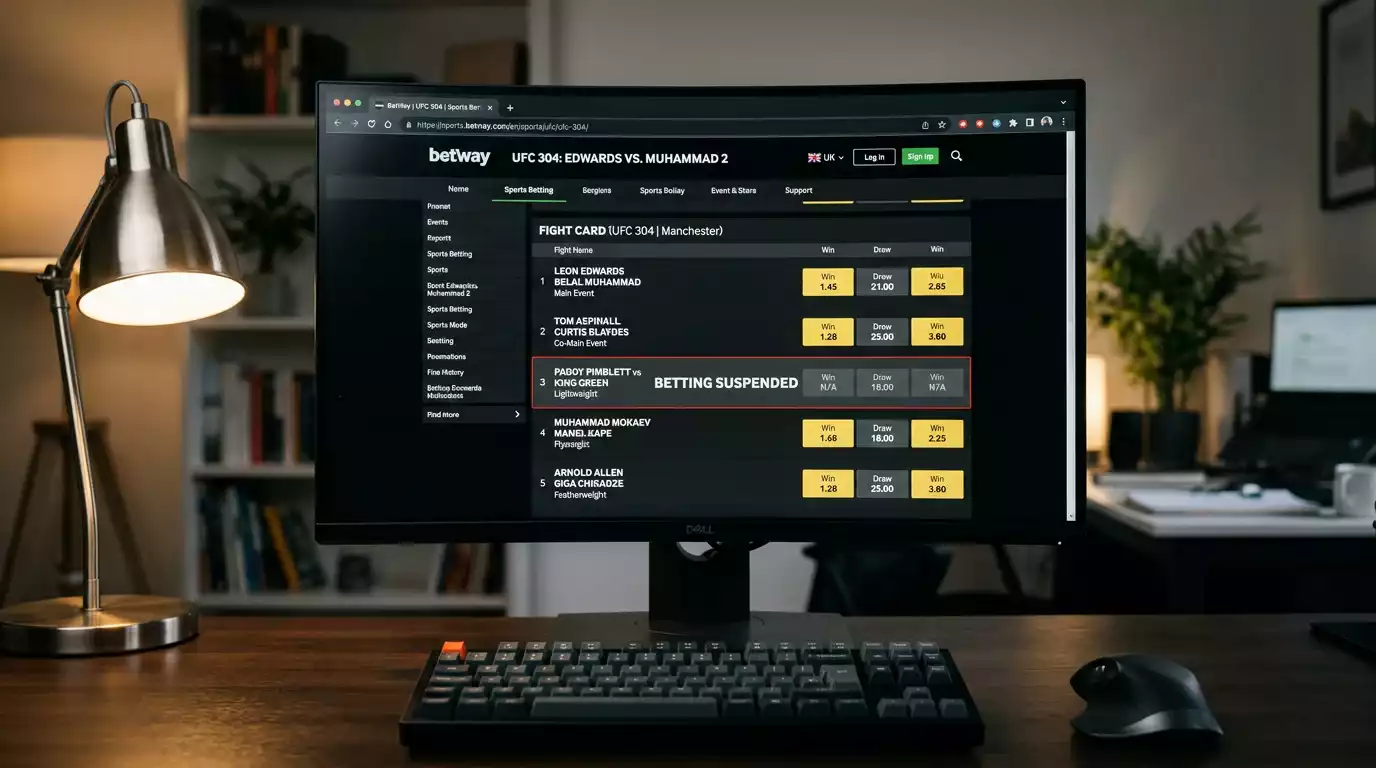
I had Isaac Dulgarian against Yadier del Valle priced on a quiet Friday in November 2025. The line had been Dulgarian -250 for a week. By the time I refreshed my model the morning of the bout, the price had collapsed to -154 — a thirty-eight percentage-point move in implied probability with no public form change, no injury report, no weight-miss. Within hours the UFC had pulled the fight, terminated Dulgarian’s contract, and Caesars and DraftKings had announced full refunds on every wager taken. That is what an integrity event actually looks like at the punter’s window: a line that does not match the form, then nothing.

The International Betting Integrity Association — IBIA — is the body that catches movements like Dulgarian’s. Their 2025 Sports Betting Integrity Report, published 3 February 2026, logged 300 suspicious betting alerts across the year, a 29% rise on the 232 alerts recorded in 2024 and the highest annual total they have ever reported. Football accounted for 110 of those alerts, tennis 74, table tennis 34, esports another 34, and basketball 27. The remainder distributed across cricket, baseball, handball, boxing, MMA, snooker, volleyball and horse racing. One MMA athlete was among the 24 players, teams or officials sanctioned across five sports after IBIA’s 2025 work confirmed 54 matches as corrupted.
Khalid Ali, CEO of IBIA, framed the 2025 picture this way
“Our 2025 data highlights a familiar integrity risk pattern, with football and tennis continuing to account for most suspicious betting activity. At the same time, the greater scale and reach of our Global Monitoring & Alert Platform means our ability to detect, assess and support investigations across markets and sports has increased.”
The infrastructure behind that statement is significant. IBIA’s Global Monitoring Platform now tracks more than 1.5 million matches across 80-plus sports against an annual betting turnover above £236 billion. The UFC plugs into this through a partnership with IC360, the integrity monitoring service that watches wagering on every UFC event. UFC’s official statement to Front Office Sports during the Dulgarian fallout read: “Like many professional sports organisations, UFC works with an independent betting integrity service to monitor wagering activity on our events. Our betting integrity partner, IC360, monitors wagering on every UFC event… nothing is more important than the integrity of our sport.”
The Dulgarian case was not isolated. In January 2026, the UFC pulled Michael Johnson against Alexander Hernandez from UFC 324 before either fighter walked out — also on integrity grounds, also flagged through IC360. Dana White’s reaction was characteristically direct: “We got called from the gaming integrity service and I said, ‘I’m not doing this s*** again,’ so we pulled the fight.” Then there is the FBI element. Unconfirmed reporting through November 2025 indicates the bureau has flagged more than 100 UFC bouts from across 2025 for abnormal betting patterns — a number that, if it holds up, would represent close to half of every UFC card the promotion ran that year.
The fighter-side rules underpinning this go back to 2022. Hunter Campbell, UFC’s Chief Business Officer, explained at the time: “The UFC’s contracted athletes are not exempt from these prohibitions, which state legislators and regulators have implemented for the purpose of maintaining the integrity of our sport.” That ProhiBet framework covers athletes, coaches, and certain operational staff. It does not stop every form of cheating — Dulgarian and the Johnson-Hernandez situation prove that — but it gives the operator and the regulator the framework to act fast when an alert lands.
For the UK punter, what changes day-to-day? Three things. Voided fights get fully refunded across regulated UK books. Operators may quietly tighten max-bet limits on lower-profile prelim fighters where alert density has been higher. And lines that move sharply against form in the final 24 hours now carry a non-trivial probability of being symptomatic of something more than just professional money. I have written the case files out in detail in the integrity cluster, including the full Dulgarian timeline.
A Data-Led Approach to Value
I have watched a hundred punters lose money on UFC by betting a hunch. I have watched maybe ten of those same punters make it back the following year by switching to a layered, metric-driven process. The single biggest mental shift is moving from “who wins” to “is this price wrong.”
The base rates tell you where the easy money is not. UFC favourites priced between -400 and -900 cash 88–93% of the time across data going back to 2013. That kind of consistency makes them attractive in isolation, but the implied probability conversion means you need a near-perfect strike rate just to break even on the price. Favourites in the +100 to -122 band — the “pick’em” zone — win only 51% of their fights, which is essentially random.
The mathematical centre of UFC betting is not “back the favourites” or “back the dogs”. It is identifying which specific underdogs are mispriced and which favourites are over-shortened.
The underdog data is where it gets interesting. Between April 2013 and November 2022, exactly 1,462 UFC fighters won as underdogs. That sample is big enough to mean something. Within it, southpaw fighters win 53% of their bouts and switch-stance fighters win 57%, both materially better than orthodox base rates. Layer in late-replacement bouts — fighters taking the fight on less than ten days’ notice — and the analysis shows positive ROI in UK markets when the line drifts beyond the favourite-equivalent, particularly inside round one.
The single metric I keep coming back to is significant strike differential. Fighters carrying a positive SSD greater than +1.5 outperform expected method-of-victory pricing systematically. When you combine that with takedown success rate above 50% and control-time data showing dominance, the resulting filter generates more clean reads in a year than any tip service does.
None of this works as a one-off. It works because you apply it consistently across a 40-card calendar, accept the variance inside it, and let the sample size accumulate. I have written the full strategy framework — bankroll maths, pricing bands, advanced metrics, edge discipline — in the strategy cluster.
Responsible Gambling: Tools and 2025 Affordability Rules
I have had two friends in nine years walk away from UFC betting because the discipline broke down. Both came back to it eventually, both used the tools the UK system actually provides — and both told me they wished they had set the limits before the spiral, not after.
The structural numbers matter for context. Around 0.5% of UK gamblers fall into the high-risk problem-gambling category, with 2.7% of adults registering as problem gamblers under the PGSI-8+ measure. In the 18–24 age bracket, 21.9% had a PGSI score between 1 and 27 across the latest survey wave. NHS estimates put gambling-related harm at £1.2 billion in annual cost. GambleAware’s 2025 research highlighted that 74% of problem gamblers identified after the fact had shown detectable behavioural changes about 14 days before reaching out for help.
Andrew Rhodes put the data clearly: “This year’s findings deepen our understanding of consequences from gambling and provide crucial insight into risk profiles among those who gamble most frequently. We strongly encourage operators to use this evidence to consider the risks within their own customer bases.”
✓ Do
- Set a monthly deposit cap before the next UFC card you bet — the October 2025 LCCP rule means the operator must show you the prompt anyway.
- Treat any losing streak longer than three consecutive cards as a signal to review your bet sizing, not to chase.
- Use the time-out function for a single weekend if a card has personal significance you cannot price calmly.
✗ Don’t
- Open additional accounts to circumvent a deposit limit you set yourself — GamStop registration covers every UK-licensed operator simultaneously.
- Increase stake size after a loss to “recover” before the next card; that is the textbook tilt pattern.
- Bet on a card while emotionally invested in a specific fighter outcome rather than the price.
Pre-Bet Checklist Before You Stake on a UFC Card
Every card I trade starts the same way: a checklist I refuse to skip even when I am certain about the read. The list is short because the items are non-negotiable, and skipping any of them has cost me money in the past.
Run this list before any UFC stake settles
- Confirm the operator’s UKGC account number sits in the site footer; if it is missing or unverifiable, the bet does not get placed.
- Verify both fighters made weight at the official ceremony and that no late-notice replacement has come into the bout in the prior 72 hours.
- Check the closing line on the opening market across at least two UK books; if the spread between them is wider than 2%, line-shop before committing.
- Cross-reference the price against your own implied-probability calculation; if your edge is under 3%, the stake is a “no bet”.
- Confirm the unit size against your bankroll percentage — 1–2% per single bet is the conservative ceiling, never higher on a method or round market.
- Set or confirm your deposit limit on the operator before the bet settles; the prompt is mandatory under the October 2025 rule anyway.
- Cross-check the IBIA and IC360 status by checking whether the bout has had any abnormal line-movement flags in the prior 48 hours.
Frequently Asked Questions
Is MMA and UFC betting legal in the UK?
Yes — provided the operator holds a current licence from the UK Gambling Commission. UKGC-licensed sportsbooks can lawfully accept stakes on UFC, Bellator, PFL, Cage Warriors, KSW, Oktagon MMA, RIZIN and any other regulated MMA promotion from anyone over the age of 18 in the UK. The licence requirement is the floor. If the operator’s footer does not display a UKGC account number that you can verify on the Commission’s public register, you are dealing with an unlicensed market and have no UK consumer recourse if the operator refuses to pay out, freezes funds, or simply disappears. Offshore and crypto-only sportsbooks marketing to UK customers are operating outside the regulated framework, and the Commission’s illegal-gambling team is actively pursuing them — Andrew Rhodes confirmed roughly 200,000 URL removal requests submitted to search engines in the most recent financial year.
What are the main MMA betting markets available at UK sportsbooks?
The six markets you will see on every UK-licensed UFC card are moneyline (two-way fight winner), method of victory (KO/TKO, submission, decision), round betting (exact round of finish), over/under total rounds (1.5, 2.5 and 4.5 lines depending on bout length), prop bets on official UFC statistics (significant strikes, takedowns, control time), and Bet Builder for combining correlated legs from the same fight. Deeper coverage adds round-and-method combinations, fight-to-go-the-distance binaries, and round handicap markets. On weaker pricing desks, prop coverage thins out faster, but moneyline and method are universal.
How do MMA odds work in fractional and decimal formats?
Fractional odds (5/4, 10/11, 2/1) display profit relative to stake; decimal odds (2.25, 1.91, 3.00) package stake and profit into a single multiplier. The maths is identical — only the display differs. UK sportsbooks default to fractional but almost all offer a decimal toggle in the user settings. The conversion is straightforward: divide fractional by its right-hand number, add 1, and you have decimal (5/4 = 1.25 + 1 = 2.25). To convert any decimal price into implied probability, divide 1 by the price. A 2.00 line implies 50%; a 1.50 line implies 66.7%; a 4.00 line implies 25%. Implied probability is the metric that lets you compare prices against your own model fairly.
Which UK-licensed bookmakers stream UFC events live?
Live UFC streaming inside UK sportsbook apps is offered by a handful of operators, but never as a blanket guarantee. Coverage is fight-by-fight, sometimes restricted to prelims, and almost always requires either a funded account balance or a qualifying stake placed within a recent window. The video usually runs at 30–90 seconds of broadcast delay, which matters for in-play traders and matters less for general viewing. The full broadcast package for UFC PPVs in the UK runs through TNT Sports as a paid subscription, separate from any sportsbook offering. Always confirm streaming availability on the specific card before depositing for that purpose alone.
What is “method of victory” in MMA betting?
Method of victory predicts how a fight ends, split into three buckets at most UK sportsbooks: KO/TKO (any stoppage by strikes including corner stoppage and doctor stoppage between rounds), submission (any tap-out, verbal submission, or technical submission such as a referee stopping the bout when a fighter goes unconscious in a choke), and decision (the fight reaches the final bell and goes to the judges). Some operators split the KO/TKO bucket further into “by strikes” versus “by stoppage type”. The market is three-way rather than two-way, which means overround sits across three prices rather than two and the implied probabilities should sum to slightly over 100%.
Can UFC fighters bet on their own fights?
No — and the prohibition has been formalised since October 2022. Hunter Campbell, UFC’s Chief Business Officer, explained at the time: “The UFC’s contracted athletes are not exempt from these prohibitions, which state legislators and regulators have implemented for the purpose of maintaining the integrity of our sport.” The framework is called ProhiBet, and it covers contracted athletes, their coaches, training partners, and certain operational staff. The Dulgarian case in November 2025 — where the line moved unusually and the bout was pulled — is the system enforcing itself. The UFC partners with IC360 to monitor wagering on every event, and the FBI has been reported to be examining over 100 UFC bouts from 2025.
How do the 2025 UKGC reforms affect UFC bettors?
Three pieces matter directly. First, from 28 February 2025 the light-touch financial vulnerability check triggers at £150 of net deposits in a rolling month — most punters never see this in action, but if you are loading higher amounts ahead of a PPV weekend, the operator must verify it is affordable. Second, from 31 October 2025 every UK sportsbook must prompt you to set a financial limit (deposit, loss, or session) before your first deposit, with a mandatory six-month reminder thereafter. Third, the statutory levy came into force 6 April 2025 with first payments due 1 October 2025, funding the new research-education-treatment framework. None of this prevents you from placing a UFC bet, but it does mean the framework around your account is more structured than it was eighteen months ago.
Created by the ”Betting mma” editorial team.