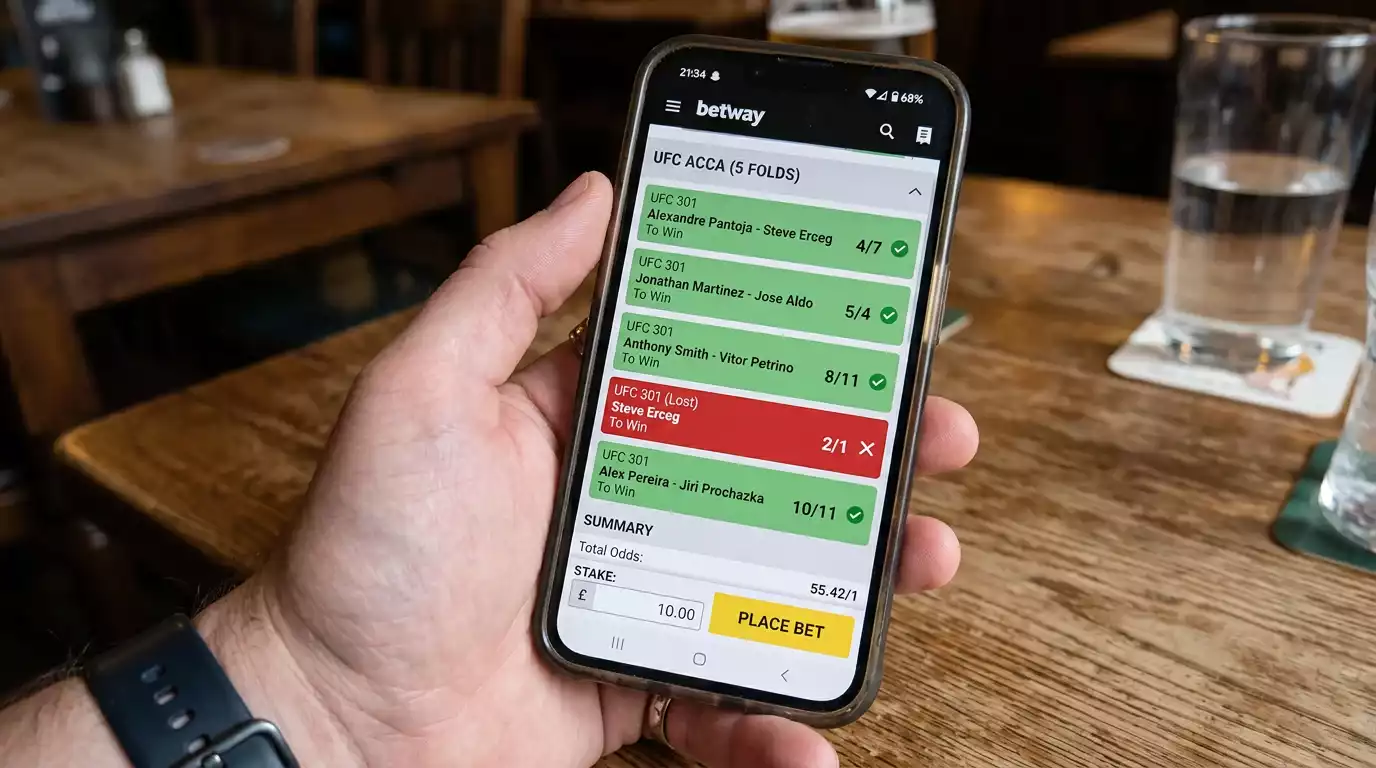
Building a UFC Bet Builder: Combining Method, Round and Props
 Available in US

The first bet builder I ever placed on a UFC card was a three-leg combination on a Fight Night main event — fighter to win, fight not to go the distance, finish in rounds one or two. The slip paid handsomely. I then spent six months trying to replicate that result by stuffing five and six legs into every ticket, and I lost steadily until I worked out why the original slip had been right and the rest had been wrong.
A bet builder is not a multiple. That is the single most useful sentence I can offer you about this product. A multiple combines legs across different events, treating each as statistically independent. A bet builder combines legs inside a single event, which means the legs are almost never independent — and the operator’s pricing engine knows it.
See how bet builders compare in our UFC parlay vs bet builder breakdown.
Legs Available on UFC Cards
Walk into the bet builder menu for any UFC bout at a UK sportsbook and the leg list is structurally identical across operators. What changes is which legs the engine will allow you to combine and which it will refuse. The refusals are themselves a tell — they tell you exactly where the book sees correlation strong enough to break the price.
The standard menu covers fight winner, method of victory in three buckets (KO/TKO, submission, decision), round of finish, over and under total rounds, fight to go the distance, fighter to win by KO/TKO, fighter to win by submission, and fighter to win by decision. Beneath these sit the prop markets — significant strikes thresholds, takedown totals, control time totals — which most builders gate behind a separate stat-prop section.
Historical UFC data is clear that fighters with a positive significant strike differential above one and a half systematically outperform their opponents in method of victory markets. That is the foundation under any builder that combines a fighter-to-win-by-KO leg with a fight-not-to-go-the-distance leg: you are layering two correlated outcomes that share the same underlying driver, and the engine will price the correlation back into your odds. Some pricing reduction is fair. Some is excessive. Knowing which is which is the entire skill.
Correlation: Where Legs Affect Each Other
Here is the question I ask before adding any leg to a builder: if leg A lands, does leg B become more or less likely? If the answer is more likely, you have positive correlation, and the operator will compress your odds. If the answer is less likely, you have negative correlation, and the operator will also compress your odds — but in the opposite direction. If the answer is genuinely independent, the engine should let the price compound freely.
Take a concrete pair. Leg A: fighter to win. Leg B: fight not to go the distance. If the fighter wins, the probability the fight ended inside the distance is higher than the base rate — finishers tend to win, decision-leaners tend to lose by decision. Positive correlation. The pricing engine will quote you something below the straight multiplication of the two individual prices.
Take a second pair. Leg A: fighter to win by submission. Leg B: over 2.5 rounds. Submissions cluster in later rounds against opponents who have absorbed damage and lost positional discipline. Mild positive correlation. The engine will trim, but less aggressively than on the first pair.
Now a counter-example. Leg A: fighter A to win. Leg B: fighter B to land over fifty significant strikes. If fighter A wins by first-round knockout, fighter B never gets near fifty strikes. Strong negative correlation. The engine should — and often does — refuse the combination outright. When it refuses, the refusal is information: the book is saying these legs are not pricing-compatible at fair odds.
The reason builders look so seductive on heavy-favourite cards is that adding a method leg to a moneyline turns a price like 1/4 into something like 5/4 or 6/4. The mathematical illusion is that you have unlocked value. The reality is that you have priced in correlation and added a second decision point on which to be wrong. Sometimes that is the right trade. Often it is not.
A Worked Bet Builder Ticket
Let me run a real-shape example without naming specific fighters. Imagine a featherweight main event where Fighter A is a -250 moneyline favourite (decimal 1.40), is a known striker with a positive significant strike differential of around plus 2.1, and has finished six of his last eight opponents inside two rounds. Fighter B is a durable counter-striker who has gone to decision in seven of his last nine.
The straight moneyline on A pays you forty pence on a one-pound stake. Useless on its own. So you start adding legs.
Leg one: A to win. Decimal 1.40.
Leg two: A to win by KO/TKO. Decimal 2.20 as a standalone market.
Leg three: Fight not to go the distance. Decimal 1.60 as a standalone market.
If you naively multiplied these three you would get a builder price of roughly decimal 4.93, or about 4/1. The pricing engine will not give you that. The three legs are positively correlated: if A wins by KO, the fight definitionally did not go the distance. The engine will likely quote you somewhere between 2.30 and 2.60 decimal, or close to 6/4. The correlation tax is roughly half the naive price.
Is that worth it? Compare to backing A to win by KO/TKO as a single market at 2.20. The builder costs you about 0.4 decimal points in price to add the redundant winner and distance legs that follow automatically from a KO outcome. That is dead money. You bought belt and braces and the engine charged you for both.
The sharper builder on the same fight looks different. Take A to win by KO/TKO at 2.20, then add an independent leg from elsewhere on the card — a separate fighter from a separate bout to land over 75 significant strikes, priced at 1.85 standalone. Two genuinely independent legs combine cleanly. The pricing engine has nothing to compress because the correlation is near zero. You arrive at a price close to 4.07 decimal, or 3/1, on a ticket where both legs were independently bets you wanted.
If you want to see how line movement around the same legs shifts inside the weigh-in window, the deeper read is in my walkthrough of how UFC lines move before the bell.
Common Pitfalls and Void Rules
The clauses to read in any builder are settlement rules under non-standard outcomes. There are four that bite punters consistently.
The first is the no-contest. If a UFC fight is ruled a no-contest — accidental headbutt, illegal strike, doctor intervention with no winner — most operators void every leg of the builder and refund the stake. A handful settle individual legs that did resolve before the stoppage. Read the specific clause.
The second is the fighter change. If one of the named fighters withdraws after the bet is placed and a replacement steps in, builders are typically voided in full. The 2025 case where the Dulgarian fight was withdrawn the day before the card and operators returned stakes is the canonical example: the betting integrity service called, the fight was pulled, and the slips were unwound. UFC president Dana White’s own line on that case – “we got called from the gaming integrity service and I said, ‘I’m not doing this s*** again,’ so we pulled the fight” – set the tone for how the industry treats integrity-pulled bouts.
The third is the round-boundary stoppage. If a fight ends at exactly five minutes of round two — bell goes mid-strike, referee waves off after the bell — the operator’s house rules determine whether that counts as a round-two finish or a round-three start. Different books rule differently. If your builder includes “finish in rounds one or two” and the stoppage is borderline, the wrong book voids your slip while the right book pays it.
The fourth is the cancellation mid-card. If a UFC card is cut short — power failure, venue evacuation, a fighter injured in warm-ups — bouts that did not take place void. Any legs of your builder tied to those bouts unwind. The remaining legs almost always void as well, since the builder is structurally a single bet on a single event.
The pitfall that loses more money than all four combined is the cosmetic leg. A “cosmetic leg” is one you added because the price was prettier with it included, not because you actually believed it would land. A ticket where one of the legs is something you would never have placed standalone is a ticket the engine has built for itself, not for you. If every leg on your builder is one you would have backed singly, you are using the product. If even one leg is filler, the product is using you.
Visit betting mma for all MMA betting tools.
How I Now Place Bet Builders
Three rules sit behind every builder I place now. First, no more than three legs unless I have genuinely independent grounds for each. Second, no leg I would not have placed standalone. Third, I always check the standalone method-of-victory price before building anything that resolves the same way the simpler bet would have done.
The product is genuinely useful when you have a strong read on a fight that goes deeper than just the winner. It is genuinely destructive when you use it to manufacture excitement on cards where you do not have a strong read at all. Like most of UFC betting, the discipline is in knowing the difference. Independent monitoring of every UFC card — the integrity partner monitors wagering on every event, and nothing matters more than the integrity of the sport, in the UFC’s own framing — means the products built on top of those cards now sit inside a much tighter compliance wrap than they did three years ago. That is a quiet feature of the modern UK builder, not a bug.
For the natural next read, my walkthrough of how the UFC moneyline market is priced continues the analysis at the next layer of detail.
Why are some bet builder combinations blocked by the sportsbook?
The pricing engine blocks combinations when correlation between legs is so high that fair pricing breaks. A leg saying fighter A wins by KO combined with a leg saying the fight ends in round one against a known first-round finisher is one example. The engine refuses because the two outcomes are nearly the same event with two labels. Treat the refusal as information: the book is telling you those legs are not pricing-compatible at independent odds.
What happens to a bet builder if a fight is cancelled mid-card?
Standard UK treatment is to void the entire builder and refund the stake when one of the named fighters does not contest the bout. Some operators settle individual legs that resolved before the stoppage, but most do not, since the builder is structurally a single bet on a single event. If a wider card is cut short due to venue issues or injuries during warm-ups, the same rule generally applies. Always read the specific clause for the operator you used.
Prepared by the Betting mma editorial staff.