Over/Under Rounds in MMA Betting
 Available in US
The first over/under line I ever priced was an under 2.5 rounds on a heavyweight bout where both fighters had finished every previous opponent inside two. The line was 1.62. I thought it was a free pound. The fight went the distance — a careful, footwork-heavy three rounds in which neither man committed to a single combination — and I had my first practical lesson in how rounds totals price the fight, not the fighters.
Rounds markets reward thinking about pace, intent and durability rather than skill or ranking. You can be entirely wrong about who wins and entirely right about whether the fight reaches the cards. That separation is what makes the market both useful and dangerous, depending on which side of it you sit.
Get more precise with UFC round betting for specific round predictions.
How the 2.5- and 4.5-Round Lines Settle
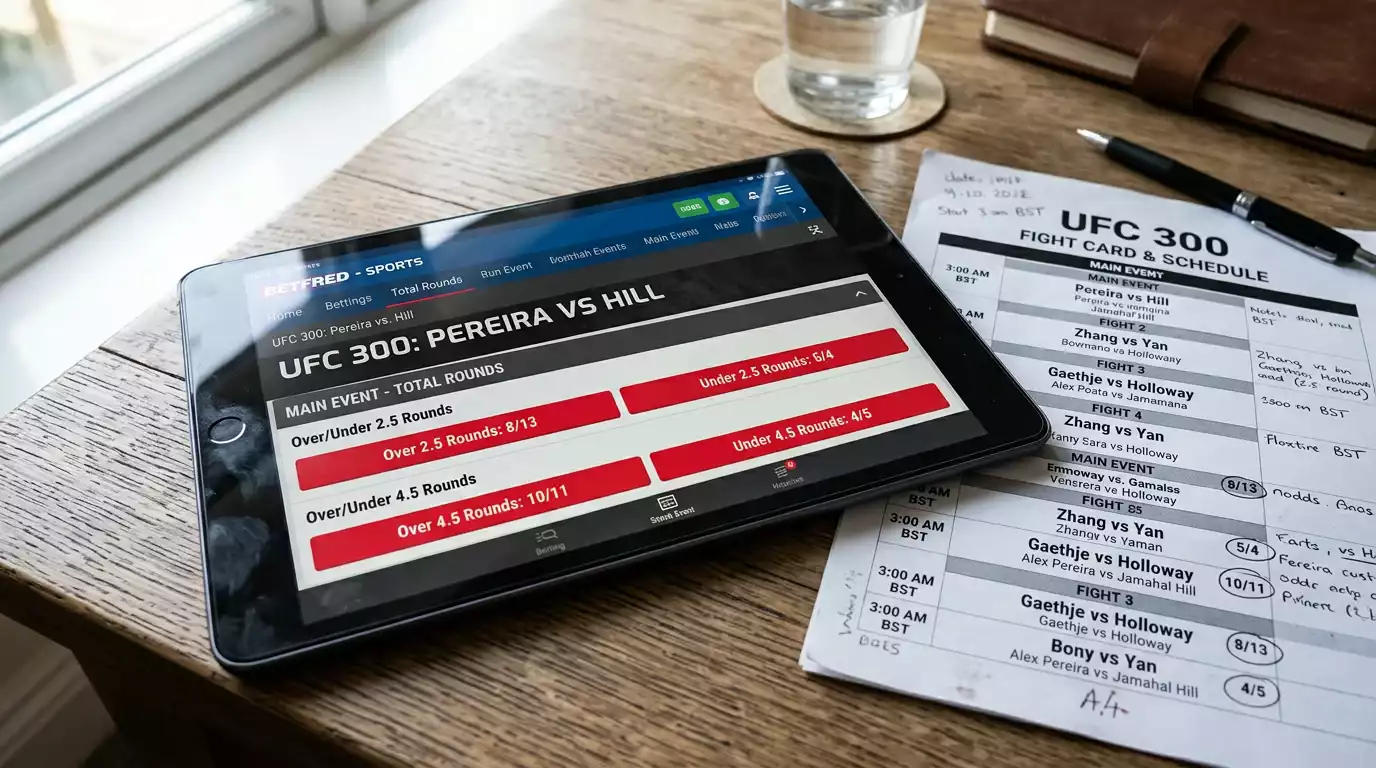
The two standard MMA totals are 2.5 rounds on three-round bouts and 4.5 rounds on five-round main events. Half-round lines exist for the same reason they exist in handicap markets — to remove the push outcome and force a binary result.
Over 2.5 means the fight passes the halfway point of round three, which is two minutes thirty seconds into the fifteenth minute of the bout. A stoppage at 2:29 of round three is under. A stoppage at 2:31 is over. The bell ending round three resolves as over by definition, since the fight has cleared the full half-round window.
Over 4.5 means the fight passes the halfway point of round five — two minutes thirty seconds into the twenty-fifth minute of a championship bout. The same logic applies. UFC’s average main-event fight time across a typical 2025 card sits well inside this window for non-finishers, which is part of why the 4.5 line is offered: it sits exactly where the empirical distribution of championship fight durations clusters, giving the operator close to equal probability on either side and the punter the maximum information density per pound staked.
UFC 326 in March 2026 drew a peak audience of 3.21 million on CBS during its broadcast minute, with a two-hour average of 2.47 million viewers — a number worth keeping in mind when you think about why operators invest in pricing precision on the headline rounds totals. Those numbers represent the betting volume the rounds market needs to clear, and the precision of the 4.5 line reflects that volume.
Three-Round Bouts: The Math Behind 1.5
The 1.5 line on three-round bouts is the round total I find most interesting, partly because most punters ignore it.
Over 1.5 means the fight passes the halfway point of round two — seven minutes thirty seconds total fight time. Under 1.5 means a finish before that point. This is a much earlier checkpoint than the 2.5 line, and it correlates almost directly with what punters call “early-finish profile” – fast-starting fighters, opponents with chin issues, weight classes where one clean shot ends the night.
The pricing on a 1.5 line typically sits asymmetric. The under tends to price at decimal 3.00 or longer, since most UFC fights do clear the seven-minute mark. The over tends to price at decimal 1.30 or shorter. The combined overround on these prices is usually wider than on the 2.5 line — operators know the under is the speculative side and price it accordingly — but the asymmetry itself is a useful read.
I use the 1.5 line as a filter even when I do not place it. If the under is priced at 2.40 instead of the typical 3.00, the book is signalling that it expects a finishable fight. If the under is priced at 4.50, the book is signalling a careful matchup or two cagey strikers. That information feeds my method-of-victory decisions even when I do not back the rounds line directly.
Five-Round Bouts: Reading the Headliner
Five-round main events change the rounds market geometrically. The bout has roughly fifty per cent more time, but the finish curve is not fifty per cent flatter — championship fights tend to start cagier and finish in a wider distribution than three-rounders.
The 4.5 line is the headline market on every UFC PPV main event. Pricing typically sits close to evens on both sides, sometimes drifting toward over 1.70 / under 2.10 when the matchup pairs two finishers, or under 1.60 / over 2.30 when it pairs two grappling-heavy decision specialists.
The trap on five-round bouts is the championship-round assumption. Many punters assume rounds four and five are slower because both fighters are tired. The empirical record across UFC main events is more nuanced. Conditioning-heavy fighters often press harder in championship rounds, knowing their opponents are fading. The “tired bout fades to decision” model is a heuristic that holds about sixty per cent of the time and fails the other forty, often spectacularly. Backing under 4.5 because “they will both be tired” is the version of the bet that costs people money.
The version that profits looks different: backing under 4.5 when one fighter has a structural advantage in cardio mid-fight, the bout pairs a finisher against an opponent on a chin-loss run, or the matchup creates an early grappling positional dominance that drains the underdog’s gas tank in rounds two and three. Those reads support an under bet that is forecasting how the fight develops, not just how long it lasts.
Style Cues That Push the Line
The four style indicators I weigh most on rounds markets are stance, pace, finishing rate and chin durability.
Stance shifts the line through striking exchange volume. Switch-stance fighters — those who alternate orthodox and southpaw mid-fight — win 57 per cent of UFC bouts in the historical sample, and they tend to do so with higher output, which pushes fights toward the over. Southpaw fighters at 53 per cent win rate sit in the middle of the distribution. Orthodox-versus-orthodox matchups are statistically the most likely to finish early when one fighter has a known one-shot weapon.
Pace correlates with takedown exchanges. A high-tempo grappler will rack up significant strikes and takedown attempts, generating action that judges score but rarely producing stoppages. High-pace, low-finish profiles push the line toward the over. Low-pace, high-finish profiles — counter-strikers with knockout power — push it toward the under, since the few exchanges that do happen tend to end the fight.
Finishing rate is the headline number but the most overstated. A fighter with a 70 per cent career finish rate against soft opposition does not transfer that rate against ranked opponents. Apply the rate to the level of the current matchup, not the career.
Chin durability is the most often missed. A fighter coming off two consecutive knockout losses has dramatically different rounds-market implications than the same fighter coming off a healthy run, even at the same moneyline price. The market sometimes prices that adjustment, and sometimes does not. The dataset of recent finishes against a given fighter is one of the highest-information signals available before you place a rounds bet.
If you want the deeper read on the binary cousin of this market — fight to go the distance as a yes/no rather than a half-round line — the natural follow-on is my walkthrough of the distance market.
Visit betting mma for all MMA round markets.
Where Rounds Markets Reward Discipline
The discipline that pays on rounds markets is the willingness to do nothing when neither side prices an edge. Many UFC cards have eight or ten rounds-totals markets and only two or three carry a read worth backing. Force the bet on the others and the four-per-cent margin grinds you down.
The single most useful thing about rounds markets is that the operator’s number is informationally clean. The book is telling you, in five digits, what it thinks the duration of the fight is. You can either improve on that estimate or you cannot. If you cannot, do not back. If you can, the line will pay you for the gap.
When does the over/under rounds line push and return stakes?
The standard half-round lines used on UFC bouts — 1.5, 2.5 and 4.5 — cannot push, because the fight cannot end exactly on a half-round mark in either direction. The bell ends each round on a clean five-minute boundary, so a stoppage at 4:59 of round two resolves cleanly as over 1.5 and under 2.5, and a stoppage at the bell resolves as over 2.5. Whole-round lines occasionally offered by smaller operators can push if the fight ends at exactly five minutes of a given round, returning the stake.
How is a stoppage at 4:59 of round one counted for the under 1.5 line?
A stoppage at 4:59 of round one resolves as under 1.5 cleanly, because the bout has not yet entered round two, let alone passed the halfway point of round two. The 1.5 line breaks at seven minutes thirty seconds of total fight time — that is, two minutes thirty seconds into round two. Any stoppage before that mark is under 1.5; any stoppage after it is over. The bell ending round one at the five-minute mark is itself the boundary between rounds, but does not in itself satisfy the over 1.5 line.
Written by the editors at Betting mma.