Round Betting in UFC: Picking the Exact Round
 Available in US
Picking the exact round of a UFC finish is the longest-priced market most punters will ever place. It is also the bet that produces more “I knew it” cash-out clips than any other corner of the menu. Round one finish at 11/2. Round two stoppage at 7/1. A bet that pays you, in a single round, more than ten moneylines could.
The reason the prices are long is the reason most of these bets do not cash: forecasting both the method and the timing of a finish is genuinely difficult. Heavy-favourite KO at 4/1 is one question. KO in round one at 7/1 is two questions, and the variance compounds.
Use round picks alongside UFC decision betting for judges’ scorecards insight.
How a Round Bet Pays
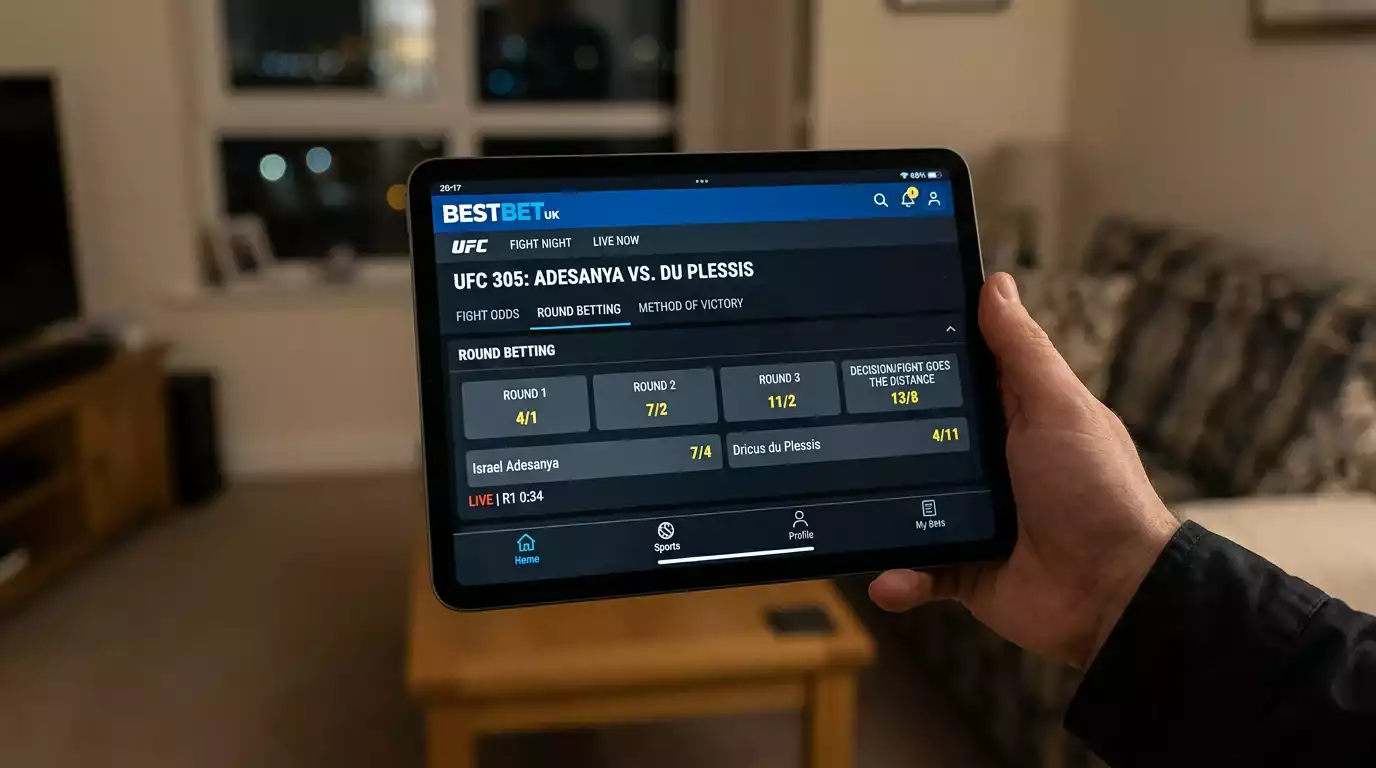
The standard menu on a three-round UFC bout offers round-of-finish bets for rounds one, two and three, plus a “fight goes to a decision” option that pays if no round finish occurs. The five-round main-event menu extends the same logic to rounds one through five plus decision.
Each price treats the round as a finishing window. If the bout ends at any point during the round you backed — from the opening bell to the closing bell, with no further qualification — the bet pays. A round-two finish settles whether the stoppage came at 0:30, 2:15 or 4:59. The market does not split the round into halves or quarters. The full five minutes of the round counts.
The pricing reflects the empirical distribution of UFC finish times. Round one is the most common finishing window across the dataset, with prices typically in the decimal 3.50 to 5.50 range for a heavy favourite, decimal 6.00 to 10.00 for a moderate favourite. Round two prices are usually similar or slightly longer. Round three on three-round bouts is the longest finishing-window price, often decimal 9.00 or more, because most fights that reach round three end on the cards.
UFC’s record-holder for shortest average fight time is Tom Aspinall at two minutes eighteen seconds. The round-one market on any Aspinall main event is priced accordingly — historically the shortest round-one finish price across UFC main events of any title-holder. Backing Aspinall by round-one finish pays you a moneyline-plus premium that captures the empirical reality, not a speculative leap.
Reading a Finisher’s Round Curve
Every UFC finisher has a finishing-round curve, and the curves are not uniform. The four shapes I look for are:
The first-round specialist. Hands cocked from the opening bell, output high in the first 90 seconds, finishing rate above 50 per cent on round-one ends across the recent record. The price on round-one finish for these fighters is short because the operator already prices the pattern, but the value sometimes sits in round-one-and-method combinations rather than the raw round bet.
The mid-fight grinder. Round one is exploratory, round two opens up, round three finishes. The price on round-three finish is typically the longest available because the operator knows most fights at round three end on the cards. Mid-fight grinders defy that base rate by finishing precisely when the operator’s model says they should not.
The cumulative-damage finisher. Each round adds damage, and the bout ends when the opponent breaks rather than from a specific moment. These fighters are difficult to back on round-of-finish because the timing is uncertain, but they often pay well on round-three or round-four bets where the cumulative effect produces a late stoppage.
The late submission specialist. Rounds one and two are spent setting up positional control. The submission lands in round three or, on five-round bouts, in rounds four or five. The price on these late-round bets is among the longest on the menu, and the hit rate among real specialists is high enough to justify the premium.
The mistake I made early was treating these curves as fixed. A first-round specialist who has fought twice at championship level and gone to decision both times is no longer the same proposition. The curve adapts to the level of opposition, and the price curve at the sportsbook adapts more slowly than the fighter’s actual record.
Round Plus Method Combinations
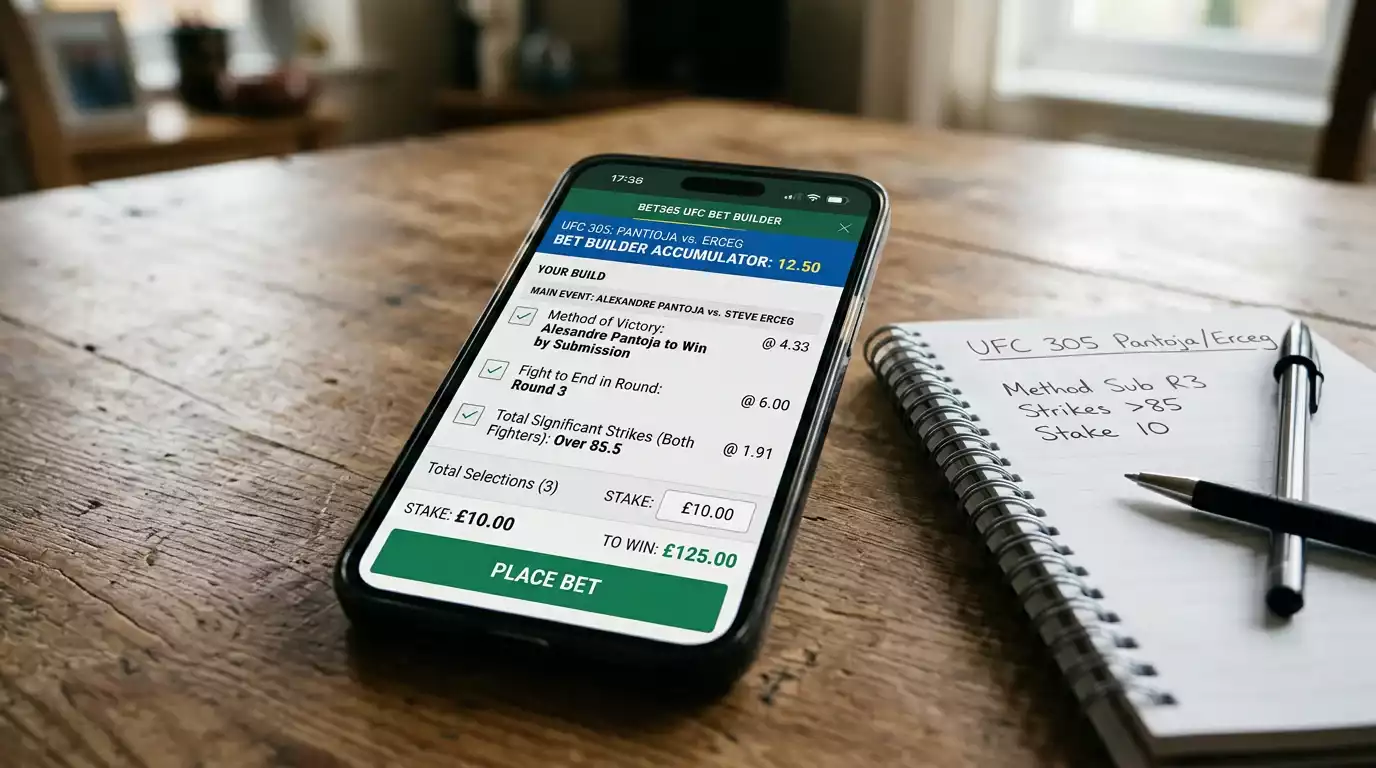
The combination market — round-of-finish plus method-of-victory — is where the most spectacular UFC bet slips are won. Fighter A to win by KO/TKO in round one. Fighter B by submission in round three. The prices stretch into double-digit decimals routinely.
The arithmetic is straightforward: if the operator prices the standalone round at decimal 4.00 and the standalone method at decimal 2.50, a naive multiplication gives decimal 10.00 for the combination. The operator’s actual price is usually shorter than that, because the round and the method are positively correlated — a round-one finish is more likely to come by KO than by decision, by definition. The correlation tax sits around 15 to 25 per cent depending on the specific pair.
Even after the correlation tax, the combination markets carry the highest variance and the highest upside on a UFC card. They are also the bets that cost punters the most over time when placed on intuition. The discipline of treating each combination as two questions — both of which need to resolve correctly — is the only way to use these markets profitably.
The single combination I have backed more often than any other across nine years is the heavy-favourite KO/TKO in round one against a chin-impaired opponent. The pattern is consistent enough across the dataset — fighters coming off knockout losses, opponents with one-shot power — to justify the variance. The pattern is not a guarantee, but it is the closest thing to a structurally underpriced combination on the UFC menu.
For the broader read on how method props interact with round timing, the natural follow-on is the deeper walkthrough in my analysis of UFC prop bets.
Live Round Betting Between Rounds
In-play markets on UFC cards offer round-of-finish prices that update between rounds. A fighter dominating round one without finishing means the in-play price on round-two finish shortens dramatically before the bell starts the second period. A fighter who appears compromised — visibly tired, cut, limping — sees the round-two finish prices shorten further.
The window between rounds is short. Most operators offer a 30 to 45 second betting window during the rest period. Prices move quickly, and the live trader is updating based on the same broadcast footage you are watching. Beating the operator on in-play requires either faster information than the broadcast feed — rarely available to punters — or a sharper read on what you just saw than the operator’s algorithm has time to process.
The cleanest in-play opportunity is the “no-finish round one” read. A fighter who has been priced as a round-one finisher fails to land cleanly in five minutes. The market for round-two finish on the same fighter often softens too much, because the algorithm overweights the lack of finish in round one. If the round-one performance suggested damage was being inflicted without quite landing the stoppage, the round-two price can carry real value.
Cash-out availability mid-round complicates this further. Some operators offer cash-out at adjusted prices during the round, others freeze the market until the bell. Where cash-out is available, it almost always pays less than the implied fair value, because the operator builds its margin into the cash-out price specifically. Use cash-out for risk management, not for value extraction.
Visit betting mma for all UFC round markets.
The Cost of Specificity
Round betting is the bet that punishes “I have a feeling” more than any other on the UFC menu. The variance is structural, the price reflects the variance, and the hit rate is low even when the reads are correct. A losing run of seven or eight round bets in a row is statistically normal across a strong portfolio.
The discipline that pays is unit-sizing the round bets smaller than moneylines, treating them as long-shot tickets within a larger bankroll, and not chasing prior losses by stretching round bets across more fights than the reads support. UFC president Dana White’s reading of the integrity wrap that now covers every card – “if you come in here to this business and you try to cheat, I will be your worst enemy” – sits as the background context. Round bets on cards that are pulled before the bell void in full, your stake returns, and your read on the round window does not get tested. That is the structural cost of operating inside a market where integrity calls can pull fights with less than 24 hours’ notice.
If a fight ends at the bell ending round two, which round does the bet pay?
A stoppage at the bell ending round two — the referee waves off mid-strike at 4:59 of round two, for example — almost always settles as a round-two finish, since the bout had not yet entered round three. The official commission timestamp is what the operator uses, and the commission almost always records a borderline stoppage as occurring in the round that the action was in, not the round that follows. The clearer case is a corner stoppage between rounds, which is officially recorded as a TKO at the start of the next round and settles accordingly.
Is there a round-six market for three-round fights?
No. Three-round bouts have rounds one, two and three, plus a decision option. There is no round-six market and no round-four or round-five on three-round fights. The five-round market exists only on championship bouts and on UFC main events that have been signed as five-round contests. The menu reflects the contracted length, not a hypothetical extension, so always check the fight contract length before backing late-round finishes.
Prepared by the Betting mma editorial staff.