UFC Acca Insurance Explained: Money Back, Free Bets and the Fine Print
 Available in US
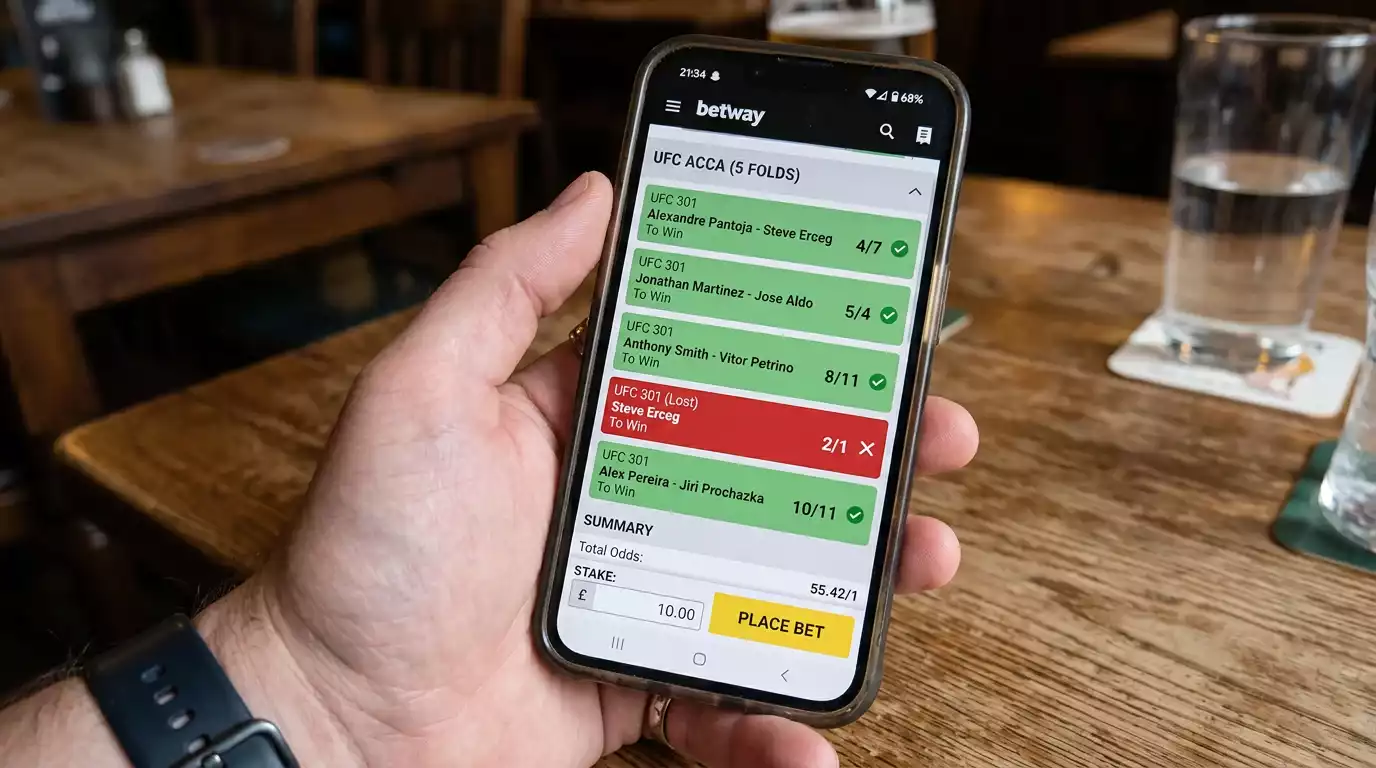
I have lost more UFC accas to one stubborn underdog than I care to admit. The fight goes the distance, the late prelim ruins the whole ticket, and the slip that should have paid four figures pays nothing. That is the precise moment acca insurance was designed to soften — and the precise moment most punters discover the small print they never read when they staked.
Acca insurance on a UFC card is not a discount, a bonus or a refund in the usual sense. It is a contractual promise from the bookmaker that, under specific conditions, the loss of exactly one leg of your accumulator will be reimbursed. The conditions are where the entire economic value of the offer lives. After nine years of working UK fight cards I have stopped treating these promos as “free money” and started treating them as a clause to read line by line.
Understand UFC cash out mechanics to manage your acca risk mid-fight.
The Refund Mechanic in Plain English
The simplest way to picture acca insurance is to imagine a five-leg UFC parlay where the headline pays at 28/1. Four legs land, one loses. Without insurance, the slip pays zero. With insurance, the bookmaker returns your stake — but rarely in cash, and almost never the full original sum.
Most UK operators settle acca insurance as a free bet token equal to the qualifying stake, typically capped at twenty-five pounds. So if you staked forty pounds and one leg failed, the cap kicks in and you receive a twenty-five-pound free bet. That token usually carries restrictions of its own: minimum odds, an expiry window, and the inability to cash out. The cash-equivalent value of that token, after factoring in expected return on a free bet versus a real-money stake, sits closer to seventeen or eighteen pounds.
This matters because the marketing copy never spells it out in those terms. “Money back as a free bet” reads like a refund. Behave as if it is one and you misprice every acca you ever build. The internal compliance regime around limit prompts and pre-deposit caps now in force at UK sportsbooks — the new mandatory financial limit prompts that operators must show before a first deposit and review every six months — has tightened the surrounding consumer-protection wrap, but it has not changed the underlying maths of the refund mechanic. The cap is the cap.
One detail the marketing copy rarely highlights: insurance triggers only when the accumulator carries exactly one losing leg. Two losers and you receive nothing. Four losers and you receive nothing. The product rewards the near-miss, not the catastrophe.
Qualifying Terms: Legs, Odds, Stake Caps
Open the terms page for any UK UFC acca offer and you will find the same three levers pulled in slightly different combinations.
The first lever is leg count. Some books require a four-fold minimum, others a five-fold, a handful go as far as six. The higher the minimum, the harder the trigger threshold but the more likely you bench a near-miss given how much of a UFC card is finishable. A four-leg minimum is genuinely useful on a stacked Fight Night because every prelim has a finisher and a grappler in opposite corners.
The second lever is qualifying odds. Each leg usually needs to clear evens — that is, decimal 2.00 or fractional 1/1. This rules out heavy moneyline favourites, which is precisely where most casual UFC accas go wrong anyway. The odds floor pushes you onto methods, rounds, props and underdog moneylines, which is healthier for the long-run portfolio even if the marketing nudge is uncomfortable.
The third lever is the stake cap. Twenty-five pounds is the standard ceiling in the UK market, with a small cluster of operators stretching to fifty for in-app or registered-customer promotions. A cap above twenty-five is genuinely useful only for punters staking three figures per slip; below that, the cap is rarely the binding constraint.
The fine print I always read twice covers void legs. If a UFC bout is cancelled — and 2025 gave us at least one high-profile pull-down where Caesars and DraftKings refunded stakes after the Dulgarian fight was withdrawn the day before the card — the standard UK treatment is to roll the remaining legs together at adjusted odds. Some operators void the entire acca, killing the insurance trigger. Others retain insurance status on the shortened slip. There is no industry default. Read the clause.
How UK Operators Vary
The mechanic is uniform; the trim is not. I have noticed three structural variations worth flagging before you build a ticket.
The first variation is the bet builder swap. Several UK books extend acca insurance to bet builder selections rather than restricting it to traditional multiples. This is a meaningful shift, because a bet builder on a single UFC main event — fight to go the distance, plus method of victory, plus over 2.5 rounds — concentrates risk in one bout and pays differently if one leg fails. A book that runs insurance on bet builders gives you a near-miss safety net inside a single fight, which is structurally different from a five-fight safety net.
The second variation is the round and method exclusion. Some operators only honour insurance on moneyline and over/under legs, excluding method of victory and exact round markets. Read this carefully. If you are building accas around late replacements where round-one edges are real — the three-year sample of late notice fighters shows positive return-on-investment when priced above the favourite line, especially in round one — and the insurance clause excludes round markets, you have just removed your safety net on the exact bets where you wanted it most.
The third variation is the recurrence cap. A handful of UK books apply insurance once per twenty-four hours, others once per week, others once per qualifying event. On a card weekend with a TUF Finale on Wednesday and a Fight Night on Saturday, that distinction can swing the practical value of the offer by a multiple.
I treat all three variations as fingerprints when choosing where to place a given acca. If my ticket leans heavily on method props, I avoid the books that exclude method legs. If my weekend involves two UFC nights, I avoid the books with weekly recurrence caps. The promo is the same name across the shopfront; the product underneath is genuinely different.
Is Acca Insurance Genuine Value?
Put a coin on the table. The honest answer is: yes, but less than the marketing implies, and only inside a specific window.
Run the maths on a five-leg UFC acca where each leg is fairly priced at 2.00 decimal. The probability of all five landing is roughly three per cent. The probability of exactly four landing — the insurance trigger — is roughly sixteen per cent. So the insurance kicks in about one in six accas if you priced them perfectly. Multiply that frequency by the free-bet value of a twenty-five-pound refund and you get an effective rebate of around two to three pounds per ten-pound acca staked. That is real, but it is not transformative.
The catch is that the qualifying conditions push you into legs at or above evens. If you would have built a 28/1 acca anyway, insurance is a free top-up. If the qualifying conditions are pulling you out of a sharper, more selective ticket into a longer one purely to satisfy the leg count, the offer has cost you more in expected value than it returns.
I work the offer in one direction only: I build the acca I would have placed regardless, then check which books cover that ticket structure with insurance, then place it at the book whose clause fits the ticket. I do not let the promo shape the slip. That single discipline is the difference between treating acca insurance as a quiet edge and treating it as a marketing lever that pulls you into worse decisions.
If you want to extend this into the wider question of how multiple legs interact and where correlation makes a ticket sharper or weaker, the deeper walkthrough in my UFC bet builder walkthrough covers the same logic applied to single-fight tickets.
Explore betting mma for the best UFC promotions.
Final Read on the Clause
Acca insurance is a useful instrument when it lines up with how you already bet. It is a misleading one when it changes how you bet. The clause is the product. The marketing line is not. Read the terms, log the stake caps, note which books cover bet builders, note which exclude method legs, and treat the refund as a free-bet token rather than a cash return. Behave that way and the offer is a genuine — small — edge. Behave otherwise and you are paying for a near-miss that pays half what you thought it did.
And keep the financial limit prompts in mind. The UKGC requires UK operators to ask you to set a deposit limit before your first deposit and remind you every six months. Acca chasing is one of the behaviours those prompts were designed to slow. Use them as a check rather than an obstacle.
Does UFC acca insurance pay in cash or as a free bet?
The standard UK settlement is a free bet token equal to your qualifying stake, almost always capped at twenty-five pounds. Cash refunds on acca insurance are rare and usually limited to specific welcome offers or registered-customer promotions. Treat the refund as a token with restrictions — minimum odds, expiry window, no cash-out — and price its real-money value accordingly.
Are method of victory legs eligible for acca insurance?
It depends on the operator. Most UK books include method of victory legs provided each clears the qualifying odds floor of evens or higher. A meaningful minority exclude method and exact-round markets from insurance triggers, which matters if your ticket leans on those bets. Read the specific clause before you stake — the headline promo name is identical across operators while the eligibility list is not.
Written by the editors at Betting mma.