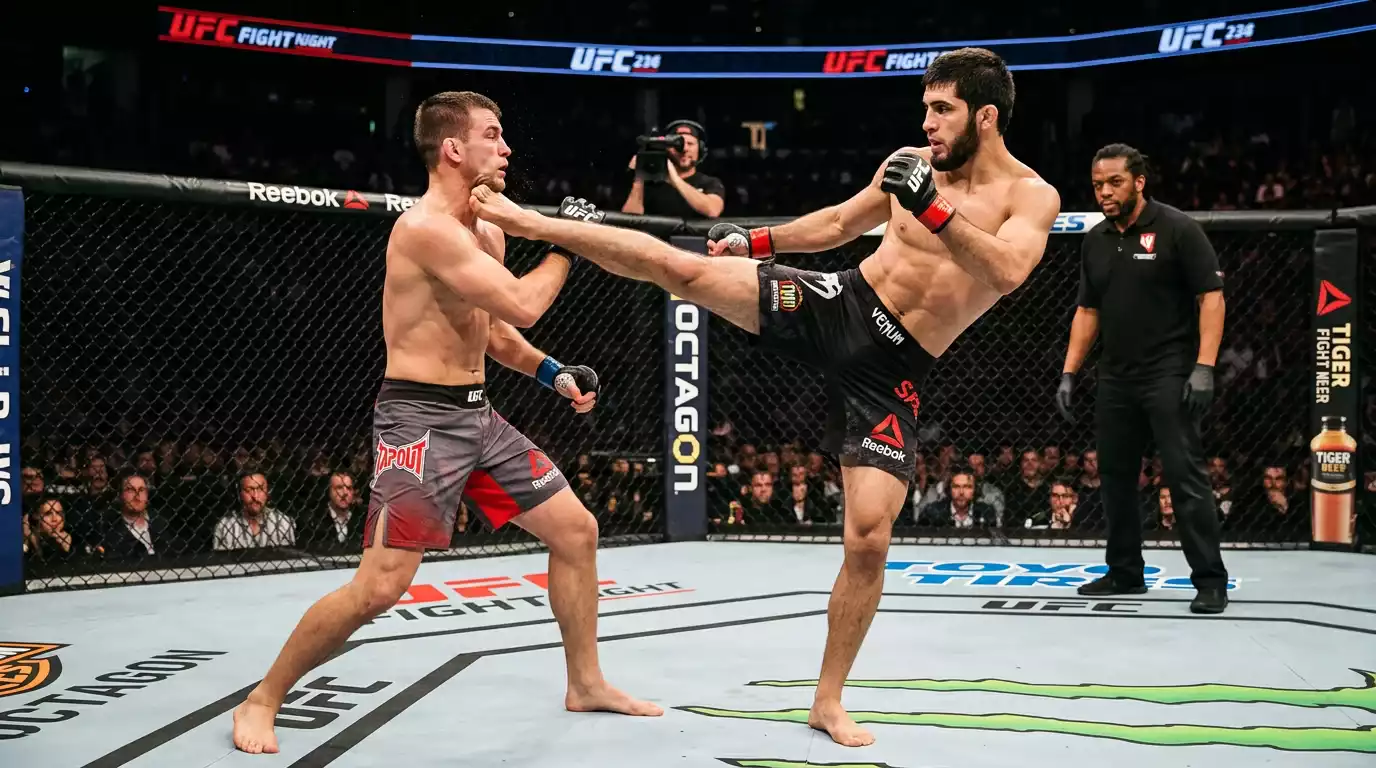
Decision Betting: Judges, Cards and Split-Verdict Risk
 Available in US

The bet I have lost most painfully in nine years of UFC punting was a fighter-to-win-by-decision at 4/1. The fighter outlanded his opponent by more than fifty significant strikes. Two judges scored it for him 29-28. One judge scored it for the opponent 29-28. Split decision, against my fighter, slip paid zero. Decision betting taught me to respect three things I had previously underrated: judging variance, the ten-point must system, and the difference between winning the rounds and convincing the cards.
Decision markets in MMA settle on the official scorecard outcome, not the technical merit of the fight. That distinction is the entire game.
Compare with our guide to UFC fight to go the distance betting.
Unanimous, Majority, Split
Three forms of decision exist in UFC scoring, and the operator’s menu typically prices the most common — unanimous decision — as the headline. The other two sit as separate prices, often longer.
A unanimous decision is the cleanest outcome: all three judges score the bout for the same fighter. This is what happens roughly 70 to 75 per cent of the time among UFC decisions, depending on the era and the matchup type. The remaining 25 to 30 per cent of decisions split between majority decisions — two judges score for one fighter, one judge scores a draw — and split decisions, where two judges score for one fighter and one judge scores for the other.
The technical decision is the rare fourth category: a fight stopped before the final bell, with the result determined by scorecards because the stoppage came from an accidental foul after a sufficient number of rounds had been completed. Technical decisions settle on the decision bucket in UK markets, but they are uncommon enough that the operator often quotes them only as a void clause rather than a priced outcome.
The pricing spread across these three outcomes tells you the operator’s view on judging variance. A fight priced “to go to a decision” at decimal 2.00, with “unanimous decision either fighter” at 2.30, signals the book sees the decision as relatively safe — the gap is small. The same fight priced “to go to a decision” at 2.00 with “unanimous decision either fighter” at 2.90 signals the book sees a higher probability of split-judge variance. Read the gap.
The Ten-Point Must System Briefly
The ten-point must system means every round receives ten points for the winner and nine or fewer for the loser. A close round is 10-9. A round where one fighter dominates without finishing is 10-8. A round where one fighter dominates and inflicts heavy damage that affects the fight’s trajectory is 10-7 in theory, though 10-7 rounds are vanishingly rare in practice.
Three-round fights settle at 30-27, 29-28, or rarely 28-27 (with one 10-8). Five-round fights settle at 50-45, 49-46, 48-47, or 47-46. The arithmetic of the ten-point must is what produces split decisions: a 29-28 result depends on which two of the three rounds were scored to which fighter, and small differences in scoring criteria — striking volume versus effective grappling, ring control versus damage inflicted — produce different round assignments for the same fight.
UFC judges score on effective striking, effective grappling, aggression, and cage control, in that priority. The first two carry most of the weight; the latter two are tiebreakers. A round where one fighter outlands the other but the other gets a takedown and rides position for two minutes is scored for the fighter who landed the volume in most cases — but not always, and that “not always” is where decision-bet variance lives.
The historical record shows favourites priced between minus 400 and minus 900 win 88 to 93 per cent of their bouts. Inside that band, decisions break heavily for the favourite, since the gap in skill is wide enough that all three judges see the same fight. Inside the slight-favourite band — minus 122 to evens, where the empirical win rate sits near 51 per cent — split decisions are far more common, because the fight is genuinely competitive and the judges are scoring from different angles.
Profiles That Reach the Cards
Decision betting requires forecasting two questions at once: does the fight reach the cards, and which fighter wins those cards. The two questions are weakly correlated. A fight reaches the cards based on durability, defence, and finishing rate. The winning side is determined by output, control and damage.
The clearest decision profile is the high-output volume striker against a durable counter-striker. Both fighters last the distance. The volume striker accumulates more landed strikes. The judges score the rounds to the volume striker. Fighter-to-win-by-decision pays at roughly the moneyline price multiplied by a factor of two, because the operator is asking you to be right about both the duration and the winner.
The second clearest profile is the grappler-with-poor-finishing-rate against a striker with elite takedown defence. The grappler controls some rounds, the striker controls the others, and the fight ends 29-28 either way. This is the canonical split-decision setup, and the operator’s “split decision either fighter” price often shortens noticeably for these matchups.
The profile that loses money most often is the “they will both be tired” decision read on a five-round bout. As mentioned in the rounds-totals discussion, conditioning-heavy fighters press harder in championship rounds, not slower. Backing fighter-to-win-by-decision on the assumption that round four exhaustion produces a points outcome is a heuristic that fails as often as it works.
For the broader question of how rounds-totals and method-of-victory markets interact with the distance bet, the natural follow-on is the deeper read in my walkthrough of round betting.
Judging Tendencies by Card Position
Cards in the UFC are not scored uniformly. The same fight, on the same night, can be judged differently depending on which judges are seated. This sounds like a conspiracy theory; it is statistical reality.
Two patterns are worth tracking. The first is the regional judging panel. UFC events in different jurisdictions use different state athletic commissions and different judge rosters. Some commissions have higher historical 10-8 rates than others. Some have higher split-decision rates. The pattern is small in any individual fight but real across a dataset.
The second is the card-position effect. Main-event judges, prelim judges, and Fight Pass early-prelim judges are not always drawn from the same pool. Late prelims sometimes see less experienced judging panels, which produces more split decisions on close fights. This is rarely priced into the operator’s lines because the public is not tracking it, which is what makes it a quiet edge for the punters who do.
A practical filter: if the bout is on the early prelim card, in a jurisdiction with a known higher split-decision rate, and the moneyline sits inside the slight-favourite band, the operator’s price on “split decision either fighter” is often longer than the empirical rate justifies. Two or three of those bets per year, identified through tracking the historical split-decision frequencies, contribute meaningfully to a portfolio of method-of-victory positions.
The integrity wrap context matters here too. UFC’s stated position — the organisation works with an independent betting integrity service to monitor wagering activity on every event — applies to decision markets as much as KO markets. A split decision that triggers an integrity alert can result in scorecard review and, in rare cases, a result change. Those reviews are extremely rare on decisions, but they exist as a tail risk.
Explore betting mma for more UFC fight outcome markets.
How I Approach the Cards Now
Decision betting rewards the punter who treats it as a forecasting problem rather than an aesthetic judgement. The market is asking two questions — distance and winner — and pricing them as a single bucket. Get both right and you collect at a price the moneyline does not pay. Get one right and one wrong and you collect nothing.
The discipline I have learned the hard way is to back the decision bucket only when I have a specific profile read on both fighters, the distance market price implies the operator sees a real chance of reaching the cards, and the moneyline does not already price the value I am chasing. If any of the three conditions fails, the bet is intuition dressed as analysis, and the operator’s margin will collect.
Does a draw count for a decision bet?
A draw — unanimous, majority or split — settles separately from the standard fighter-to-win-by-decision market. If you backed fighter A by decision and the bout ends in a majority draw, the bet loses, because the official result was not a fighter-A decision win. Some operators offer a separate draw market that prices the outcome explicitly, sometimes paying double the long-side decision odds. Draw outcomes are uncommon in UFC bouts but they happen often enough on three-round prelims that the void rules are worth checking.
How are technical decisions settled?
A technical decision occurs when a fight is stopped before the final bell due to an accidental foul, after a sufficient number of rounds have been completed for the scorecards to determine a winner. UK sportsbooks generally settle technical decisions on the decision bucket, paying the same as a standard decision result. A small minority of operators treat technical decisions as voids and refund stakes. The clause sits in the operator’s MMA-specific settlement rules, which differ from the general method-of-victory clause, so check before staking.
Written by the editors at Betting mma.