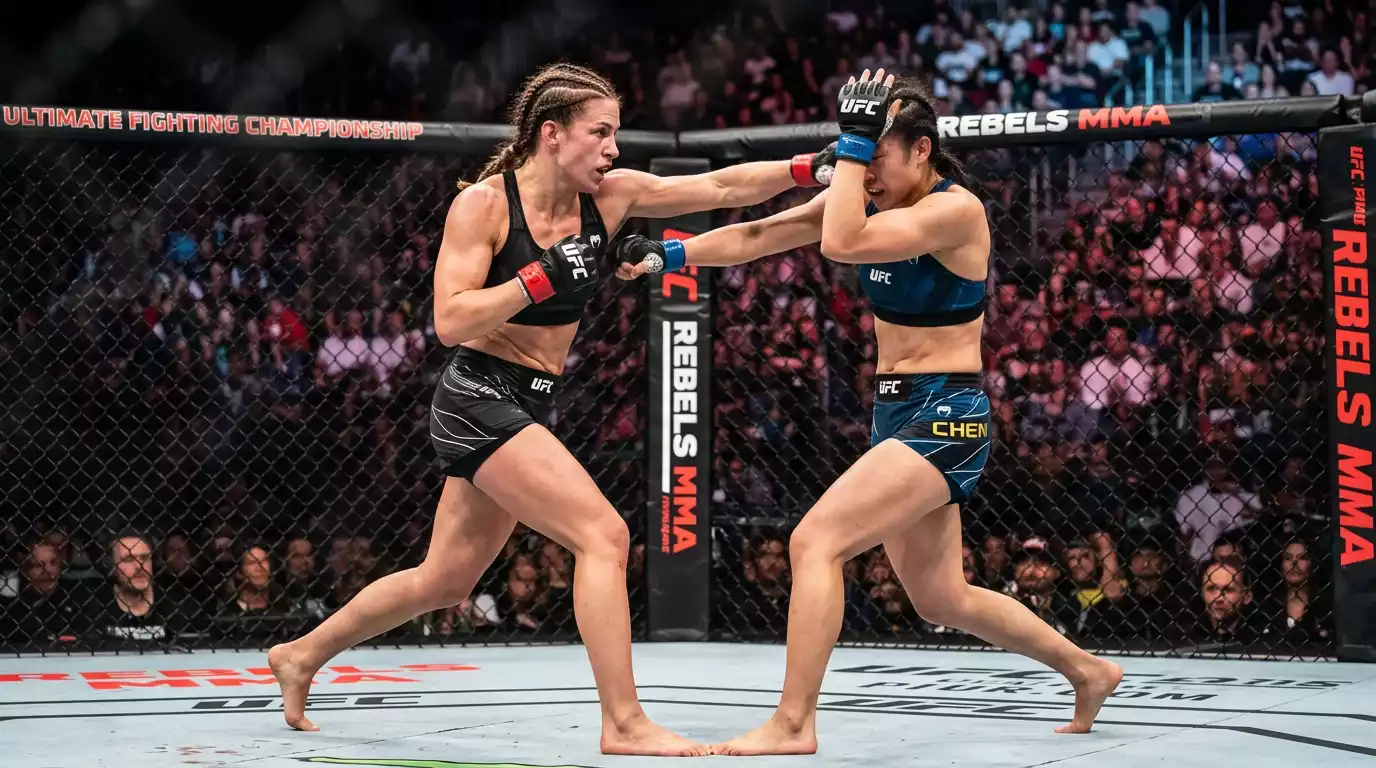
Significant Strike Differential: A UK Bettor’s Edge Metric
 Available in US

If I had to give up every metric except one for betting UFC fights, I would keep significant strike differential. Not because it is the most predictive single number — no single number predicts MMA outcomes well — but because it is the cleanest one-line summary of style that the operator does not always price into the line correctly.
The first time the metric paid me unambiguously was a featherweight bout where the moneyline favourite was sitting on a strike differential of plus 2.3 against an opponent at minus 0.4. The operator priced it as a competitive fight on the assumption of similar output. The fight ended in a round-two TKO. The differential told a story the price did not.
Apply strike stats to predict the UFC method of victory more accurately.
How SSD Is Calculated
Significant strike differential is the difference between a fighter’s strikes landed per minute and strikes absorbed per minute, calculated across a chosen sample. The methodology is straightforward in concept, fiddly in detail.
For each bout in the sample, count the fighter’s official significant strikes landed and divide by total fight minutes — so a 15-minute fight where the fighter landed 75 strikes gives 5.0 strikes per minute. Then count strikes absorbed using the opponent’s landed count, divide by the same total fight minutes — a 15-minute fight where the opponent landed 45 strikes gives 3.0 strikes per minute absorbed. Subtract: differential of plus 2.0 for that bout.
Career SSD averages each bout-level differential across the fighter’s career. Recent SSD averages across the last three, five, or eight fights, depending on the analyst. I use a rolling five-fight window because it captures recent form without being too noisy on small samples. Career SSD is useful for context but is a lagging indicator that often misses recent style shifts, weight class changes, or injury layoffs.
The historical UFC data on fighters with positive SSD above plus 1.5 systematically out-finishing the field is the empirical anchor for using the metric. The plus 1.5 threshold is not arbitrary — it is the level at which the differential is large enough to overcome the variance of any single fight and signal a real stylistic edge.
The +1.5 Threshold
Why plus 1.5 specifically? Because below that level, the differential is dominated by sample noise. A fighter with SSD of plus 0.6 might be a slightly higher-output striker than his opponents, or might be a balanced fighter who happened to face a couple of lower-volume opponents. The differential carries information but not enough to act on confidently.
Above plus 1.5, the gap is structural. A fighter landing one and a half more strikes per minute than he absorbs is not running hot on a small sample; he is operating in a different stylistic class from the opponent over the long run. That structural gap shows up in finish rates, in distance-market outcomes, and in method-of-victory pricing.
The operator knows the threshold exists. The operator’s pricing model uses some version of strike differential as an input. The edge does not come from knowing the metric. The edge comes from knowing which fighters’ current SSD is meaningfully different from their career or model-implied SSD, and acting before the public moves the line.
The strongest plays I have made on the metric have not been on fighters above plus 1.5 against fighters below plus 1.5 — those bouts are usually priced reasonably. They have been on fighters whose recent five-fight SSD has shifted from plus 0.6 to plus 2.1 because of a weight class drop, a new striking coach, or a style adjustment that the operator’s career-weighted model has not yet caught.
SSD Across Weight Classes
The metric does not translate cleanly across weight classes, which is one of the most overlooked details in using it.
Heavyweight fighters typically post lower absolute SSD numbers, because the absolute strike volume per minute is lower across the division. A heavyweight at plus 1.0 SSD is the equivalent style profile of a featherweight at plus 2.0. The threshold has to flex with the division.
Featherweight, bantamweight and flyweight produce the highest absolute SSD numbers across the dataset, because the strike volume per minute is highest at the lower weights. A flyweight at plus 3.0 is operating in the same structural position as a heavyweight at plus 1.2 — high relative to division average — and his pricing edge is roughly equivalent.
The error I have seen punters make is comparing a heavyweight at plus 0.8 unfavourably against a flyweight at plus 2.0, assuming the flyweight has the bigger edge. The relative position within the division matters more than the absolute number. Adjust for division before reading the metric.
UK fighters carry their own division-specific footprint. UFC heavyweight champion Tom Aspinall holds the record for shortest average fight time at two minutes eighteen seconds. His SSD is exceptional within the heavyweight division — not because he absorbs few strikes, but because he lands many strikes in very short fight windows, which skews his per-minute numbers upward dramatically.
Combining SSD with Takedown Rate
SSD on its own captures striking efficiency. It does not capture grappling outcomes. A fighter with SSD of plus 0.4 who lands four takedowns per fight and absorbs minimal damage on the feet because he spends most rounds on top is not a worse fighter than a striker with SSD of plus 2.0 — he is operating in a different stylistic frame the metric does not see.
The combined read is SSD plus takedown landing rate per fifteen minutes. The three-year sample of late-replacement fighters showed positive return-on-investment in UK markets when they were priced above the favourite line, with much of that ROI concentrated in fighters whose combined striking-plus-grappling profile the line failed to price. A wrestler-striker hybrid with SSD of plus 0.8 and three landed takedowns per fight has a different total game from a pure striker with SSD of plus 1.8 and zero takedown attempts.
The cleanest read I have found is the SSD-plus-takedown-defence combination. A fighter with positive SSD whose opponent has poor takedown defence is signalling a high-output striker who will not be slowed by grappling exchanges, which compounds the SSD edge rather than diluting it. A fighter with positive SSD whose opponent has elite takedown defence faces a fight that stays standing — the SSD edge transfers fully.
The combination that most often breaks the SSD signal is a positive-SSD striker against an opponent with elite takedown offence and average takedown defence. The fight may go to the ground regardless of intent, and the striker’s SSD edge becomes irrelevant once the fight stops being standing exchanges. UFC’s reading of its own card-level integrity ecosystem – “like many professional sports organizations, UFC works with an independent betting integrity service to monitor wagering activity on our events” – is the wider context, but the specific point here is that SSD edges on fights that end up on the ground are quieter than the metric suggests.
For the deeper read on how late replacements specifically interact with strike-differential reads and round-of-finish markets, the natural follow-on is my walkthrough of late replacement betting in UFC.
See also: betting mma for data-driven MMA analysis.
What the Metric Cannot See
SSD does not capture chin durability. A fighter with plus 2.5 SSD coming off two knockout losses is a different proposition from the same fighter coming off a healthy run, and the SSD does not adjust. You have to overlay chin-loss data manually.
SSD does not capture cardio. A fighter who posts plus 2.5 across the first ten minutes of his recent fights but fades in round three has a different SSD profile in round three than the average implies. The metric needs to be looked at by round, not just by fight, to catch fade patterns.
SSD does not capture grappling exchanges that disrupt striking output. A fighter who lands takedowns and rides position scores low on strike-rate-per-minute even when winning rounds clearly. The SSD will understate his ability against the wrong type of opponent.
The metric is a starting point, not an answer. It does what every good betting metric does: it gives you a question to ask, not a conclusion to take. Where the SSD differs sharply from the operator’s line is where the question gets interesting. Where it matches the operator’s line, your edge has to come from somewhere else.
Does significant strike differential include head, body and leg strikes separately?
Most analysts use total significant strikes as one number, but more granular versions of the metric break it down by target — head, body, leg — to capture style differences. A fighter with high body and leg differentials but low head differential is operating differently from a fighter with the reverse profile. The published UFC stats provider tracks both the total and the breakdown, so the granular version is available for any analyst willing to do the work. For most pricing edges, the total significant strike number is sufficient.
What sample size is required for SSD to be meaningful?
A rolling five-fight window across the recent record is the practical minimum for SSD to carry signal beyond noise. Three-fight windows are too small and produce dramatic swings on any single bout outlier. Career-long SSD averages are too lagging and miss recent style shifts. The five-fight window balances recency with sample size, and it is the number I use across nine years of UFC analysis. Different analysts use different windows, but the principle — enough fights to dampen noise, recent enough to catch shifts — is the same.
Created by the ”Betting mma” editorial team.