Suspicious UFC Betting in 2025: A Case File
 Available in US
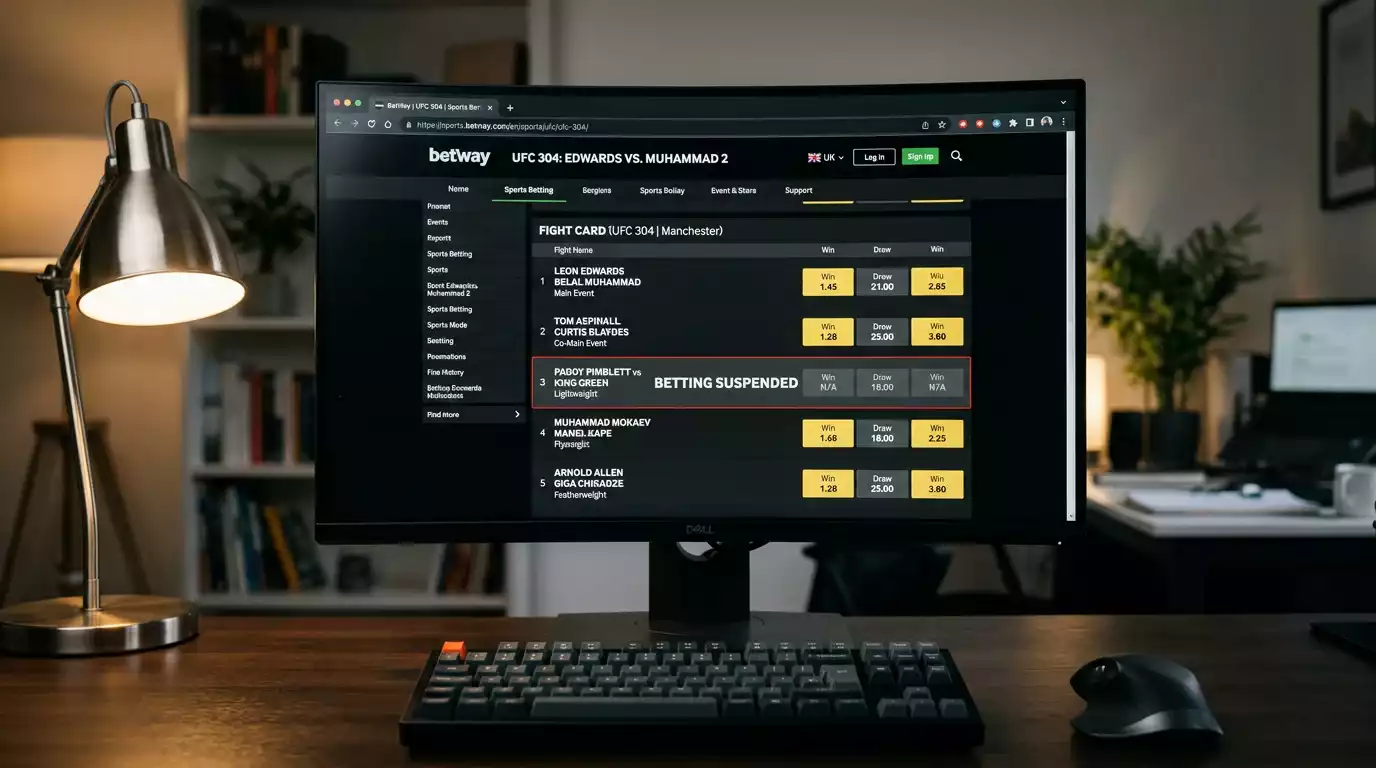
The November call I will never forget came on a Friday night before a UFC card. A friend who works trading at a UK book messaged: “Dulgarian fight just got pulled. Refunds being processed.” I had not staked on the bout, but I had been watching the line move all week with growing unease. The price had been compressing in a way that made no sense from a fight-modelling perspective, and the integrity service had clearly been watching the same compression for days before the pull.
2025 reshaped how UK punters need to think about UFC betting. Not because the sport changed — it did not — but because the integrity infrastructure around it visibly hardened, and the cases that resulted made the cost of that hardening transparent.
Understand the safeguards in our UFC betting integrity and IBIA/IC360 overview.
Dulgarian vs Del Valle: Line, Pulldown, Refunds
On 1 November 2025, the day before the scheduled bout between Joshua Dulgarian and Yadier del Valle, the coefficient on Dulgarian collapsed from minus 250 to minus 154. That kind of move on a fight on a Saturday card, with no announced injury, no announced lineup change, no fight-week story, was the structural signal that triggered the integrity response.
The standard pattern with line moves of that magnitude is that they have a public-facing explanation — a corner change, a sparring-camp injury leak, a fighter’s social media indicating illness. The Dulgarian shift had none of those. The integrity service flagged it. The information went to the UFC. The fight was pulled. Caesars and DraftKings returned stakes on the bout.
Dana White’s account of the pull was characteristically direct: “we got called from the gaming integrity service and I said, ‘I’m not doing this s*** again,’ so we pulled the fight.” The decision was made in hours, not days. The contract with Dulgarian was subsequently terminated. The bout did not happen.
For UK punters, the immediately relevant detail is that stakes were refunded. The integrity-pulled bout did not produce winners and losers under any of the betting market’s outcome buckets — moneyline, method, round, prop, distance — because there was no fight. Operators voided the markets entirely and returned stakes in full. The downstream effect on accumulator slips that included the Dulgarian bout was to recalculate the remaining legs at the unchanged combined odds, with the pulled leg removed.
The broader case sat inside a 2025 in which the International Betting Integrity Association recorded 300 suspicious betting alerts across all sports, a 29 per cent rise from the 232 alerts of 2024 and the highest annual total IBIA has logged. MMA appears in the IBIA’s residual category alongside boxing, snooker, volleyball, handball and others, and the organisation confirmed 54 matches as corrupted across the year, with sanctions applied to 24 athletes, teams or officials across five sports including one MMA athlete.
Johnson vs Hernandez at UFC 324
On 24 January 2026, the scheduled bout between Michael Johnson and Alexander Hernandez at UFC 324 was withdrawn before the cards entered the octagon. The trigger was again an integrity alert, this time identified early enough to remove the bout from the card before the bell rather than the day before.
The pattern of identification — alert before, not after — matters. It signals that the integrity ecosystem’s monitoring has moved beyond simple post-event review into prediction and prevention. The bout was pulled. The market voided. UFC’s statement around the pull confirmed the integrity-service involvement without naming specific patterns or actors.
The IBIA’s CEO Khalid Ali captured the wider trend earlier in 2026: “our 2025 data highlights a familiar integrity risk pattern, with football and tennis continuing to account for most suspicious betting activity. At the same time, the greater scale and reach of our Global Monitoring & Alert Platform means our ability to detect, assess and support investigations across markets and sports has increased.” MMA sits inside that wider monitoring net, and the Johnson-Hernandez pull was the visible product of the platform’s growing reach.
For punters with stakes on the UFC 324 card, the bout pull resolved the same way the Dulgarian case had resolved — stakes refunded, slips recalculated. The structural lesson is that any UFC bout, on any card, can be pulled with less than 24 hours’ notice if the integrity service identifies a pattern. Operating capital that punters thought was committed for the weekend can be returned at any point in the run-up to the bell.
The FBI Reporting on 100+ Bouts
The third strand of the 2025 case file is the FBI’s reported scrutiny of more than 100 UFC bouts for abnormal betting patterns. The reporting on this scope, originally surfaced by legal analysis outlets, has not been formally confirmed by either the FBI or the UFC, but the volume implied — over 100 bouts — represents a meaningful share of the year’s roster.
The pattern of investigation reportedly focused on betting on prop markets — specific round finishes, method-of-victory legs, distance bets — rather than on outright winners. Prop markets are inherently more susceptible to inside-information exploitation because the outcome depends on a specific event that can be influenced without affecting the broader result of the fight.
The UFC’s response, in its own framing, has been consistent throughout: “like many professional sports organizations, UFC works with an independent betting integrity service to monitor wagering activity on our events. Our betting integrity partner, IC360, monitors wagering on every UFC event… nothing is more important than the integrity of our sport.” The IC360 partnership predates the 2025 cases but came into much sharper public focus through them.
For UK punters, the practical implication is that prop bets on bouts under heightened scrutiny may settle with delay, may be subject to retroactive review, and in rare cases may be voided if the underlying outcome is itself ruled compromised. This is a tail risk rather than a frequent occurrence, but it is now a real consideration in how to think about prop staking on cards involving fighters with any audit shadow over their recent record.
What This Changes for the Next Card
Four operational changes follow from the 2025 case file for any UK punter approaching a 2026 UFC card.
The first is to expect more aggressive market suspensions in the run-up to bouts. Operators are now more responsive to unusual late-week activity, suspending markets on shorter triggers than they did in 2023 or 2024. Markets that suspend twice in a fight week are not necessarily signalling trouble, but they are signalling caution that did not exist before.
The second is to read line movement more sceptically. A 35 per cent compression on a moneyline in the absence of a public-facing explanation should now be a flag rather than an opportunity. The Dulgarian-shaped move was the canonical example of how this can resolve, and it resolved by pulling the bout and returning stakes. Backing into a compressing line that has no narrative justification carries the risk of catching the move just before the bout disappears.
The third is to factor cancellation risk into bankroll allocation. A 2026 UFC card week now carries a non-trivial baseline probability of one bout being pulled for integrity reasons. The base rate is still small — most cards complete with all bouts intact — but it is high enough that staking the full bankroll on a single bout that might disappear is a different proposition from staking the same bankroll on a bout that has cleared the integrity window.
The fourth is to take the IC360 monitoring seriously as a feature of the modern UFC betting environment rather than as background noise. Khalid Ali’s framing of the IBIA’s strategic roadmap captures it: “as IBIA marks its 20th anniversary, we are not only reflecting on the past, we are also looking ahead to the future. Our new strategic roadmap charts how we will continue to deliver best in class integrity services to our members, deepen collaboration with our partners, and successfully confront the challenges and opportunities reshaping our industry.” The roadmap reaches forward, not back. The cases of 2025 are the first wave, not the last.
For the deeper read on how the IC360 system works mechanically and what ProhiBet restricts at the athlete level, the natural follow-on is my walkthrough of the ProhiBet and IC360 architecture.
See also: betting mma for the latest MMA wagering guides.
The Punter’s New Posture
I do not place differently in 2026 than I did in 2024. I place more selectively, with smaller props, with greater attention to line movement in the absence of narrative, and with a clearer awareness that any bout can be removed from the slate at any time. The integrity wrap is not an inconvenience to bet through. It is an infrastructure that protects the long-run value of the markets I rely on, and the cost of that protection is occasional refunded stakes on bouts that should not have been on the card.
The cases of 2025 are the case file the next decade of UFC betting will reference. Worth reading them once, then operating accordingly.
Are voided bets on pulled UFC fights always refunded in full?
At UK-licensed sportsbooks, the standard treatment for an integrity-pulled bout is full stake refund on every market that did not resolve. Moneyline, method, round, prop and distance markets all void. The refund is processed to the original payment method, typically within 24 to 72 hours, though the exact window varies by operator. The downstream effect on accumulators is to recalculate the slip with the pulled leg removed, treating it as a void leg under the operator’s standard multi-bet rules. Some smaller operators settle slightly differently — always check the void clause on the specific sportsbook you used.
Will UK sportsbooks publicly flag specific fighters under integrity review?
No. Operators do not publish names of fighters under integrity review, both because the reviews are confidential to the integrity service and because public flagging would itself distort markets in ways the review is designed to prevent. The visible signals to punters are market suspensions, unusual line movements without narrative, and bout pulls. None of these confirm any specific allegation, and the integrity service’s findings — when they result in athlete sanctions — are reported in aggregate through the IBIA’s annual report rather than through operator-side announcements during the season.
Published by the Betting mma team.