Live In-Play Betting on UFC: Reading the Cage in Real Time
 Available in US
The first in-play bet I ever placed was on a UFC main event where the favourite ate a counter hook in the opening minute and folded onto the canvas. By the time the referee waved off, I was up forty quid on a stake I had placed forty seconds earlier. The second in-play bet I placed was a chase against the same favourite the following month, and I lost the lot to a slow-burn decision. Both bets taught the same lesson: the price moves faster than your read, and most of the time the price is right.
Live in-play betting on UFC is the most technically demanding market on the menu. The lines update every ten or fifteen seconds. The mechanic is opaque. The variance is brutal. But the edges, when they exist, are genuine, and they are not available on the pre-fight markets at all.
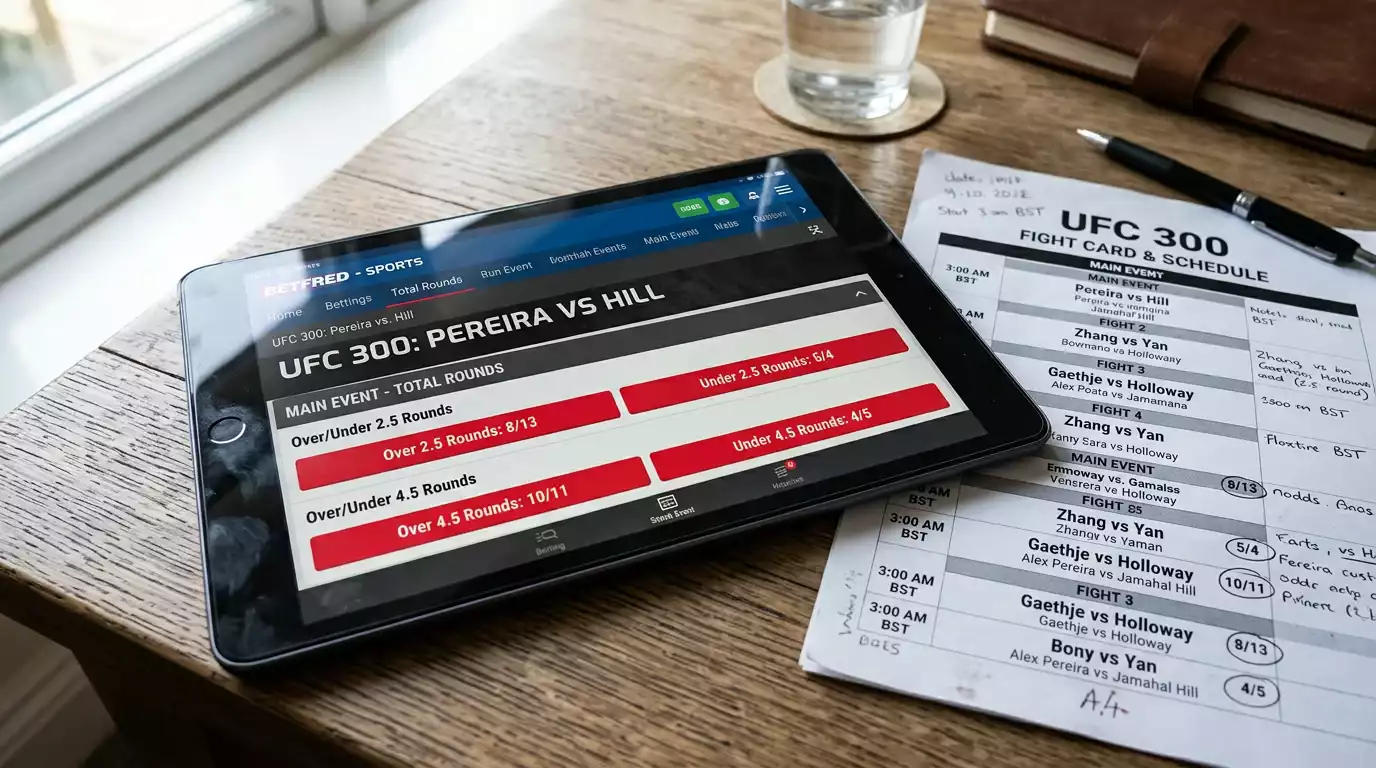
Use live data to bet MMA over/under rounds as the fight unfolds.
The Pricing Engine in Live
The live pricing engine is a continuously updated probability model. It ingests round-by-round and minute-by-minute data — strikes landed, takedowns attempted, control time, position changes — and outputs revised win probabilities for each fighter every few seconds. The displayed odds are those probabilities, plus the operator’s margin, minus a buffer for the model’s uncertainty about the most recent action.
The lag between cage action and price update is typically between five and fifteen seconds. The lag is structural — the engine needs to receive the data, run it through the model, apply the margin, and push the updated odds to your screen. That lag is the entire window in which a sharp punter has any informational edge over the engine. If you cannot read the action faster than the engine, you have no edge. If you can, the edge is real but small.
The margin on live markets is wider than on pre-fight markets. A four per cent moneyline margin on the pre-fight line widens to six or seven per cent in live. The margin compensates the operator for the increased model uncertainty and for the fact that some live punters genuinely do read the cage faster than the engine. Most do not, but the operator prices for the ones who do.
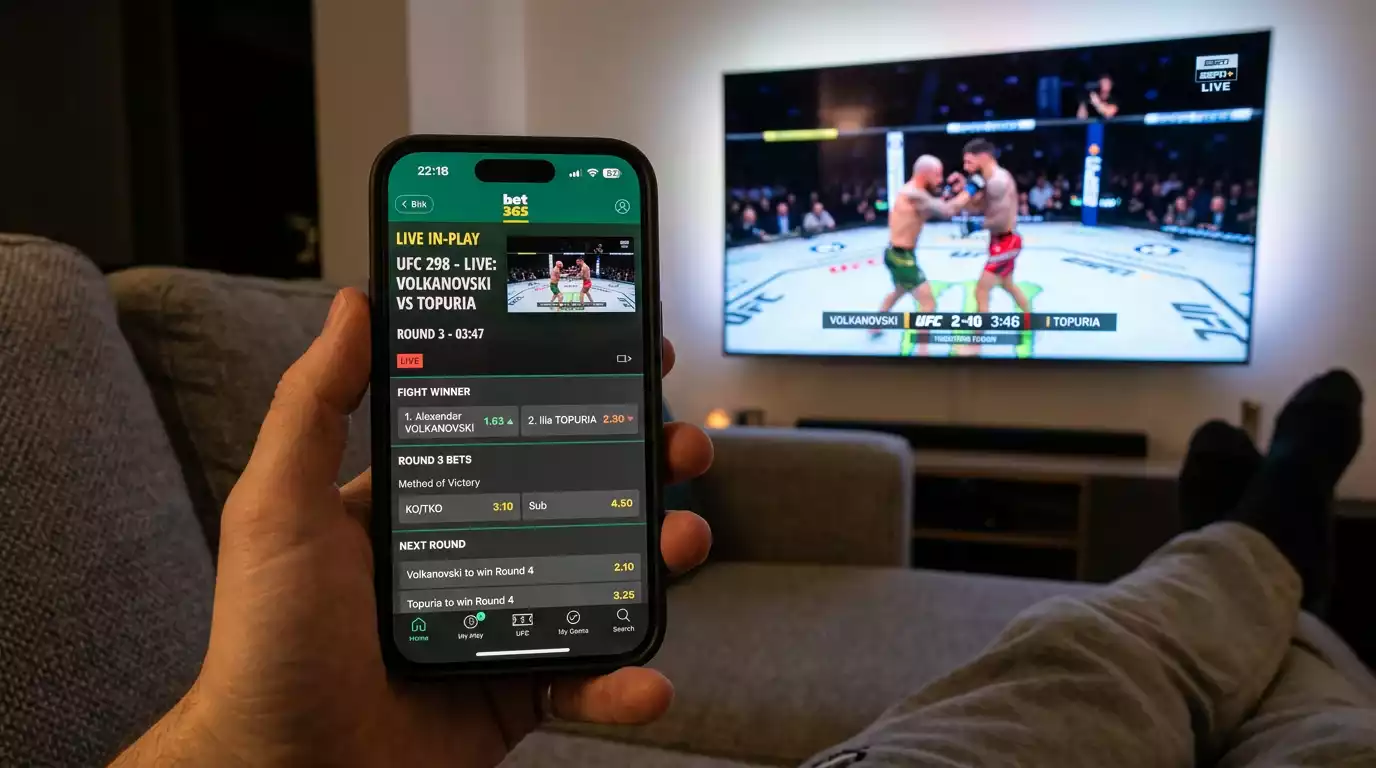
Live markets typically include moneyline, current-round winner, next round to start, total rounds, and method of victory, with bucket structures that mirror the pre-fight menu but at compressed odds reflecting the action that has already happened. A favourite who was minus 250 pre-fight and has won round one cleanly typically prices around minus 600 going into round two. The same fighter dropped briefly in round one but recovering prices around minus 180 going into round two. The engine’s reaction to events is its most useful informational signal.
When Live Markets Open and Close
UK operators typically open live markets when the cage door closes and the announcer starts the introductions. Some open earlier — immediately after the prior bout ends — with limited markets. The full live menu is usually live from the bell starting round one through to the official result announcement.
Markets suspend in three specific scenarios. The first is between rounds. Most operators suspend live markets for the 60-second break between rounds, reopening them as round two starts. The second is during stoppage reviews — referee or doctor checking a cut, briefly stopping the fight. The third is during a knockdown or near-finish, where the engine cannot price the outcome with confidence and the operator suspends rather than risk mispricing.
The suspension during near-finish events is the structural reason live markets cannot reliably be used to chase momentum at the moment of greatest swing. You see the knockdown. You reach for your phone. The market is suspended. By the time the market reopens, the price has fully adjusted to reflect the new state, and the swing you wanted to back has already happened in the line.
This is not a flaw of the operator. It is a structural feature. The market knows what you know, plus the lag, minus the suspension buffer. The window in which your read beats the engine is the unsuspended period when nothing dramatic is happening but the data underneath the line is shifting in a direction the engine has not fully priced.
Where Live Edges Actually Exist
Three categories of edge exist in live UFC markets, and recognising them takes discipline rather than just attention.
The first is the cardio read. A fighter visibly fading in round two — hands lower, breathing through his mouth, footwork slower — will lose more rounds going forward than the engine has yet priced. The engine processes strike data and position data, but it does not directly score visible fatigue. A trained eye picks up the fade three to five strikes before the engine does. The live moneyline on the fading fighter is short during that window. Backing his opponent is the canonical cardio-read live bet.
The second is the corner instruction signal. Cornermen who switch tactical instructions between rounds – “stop pressing forward, work the body” – are signalling that the corner has noticed a structural weakness the engine has not. If you can hear the corner work clearly on the broadcast feed, the instruction is information. The engine cannot hear the corner. You can. The window between the corner’s instruction and the fighter’s execution of it is the window in which the live line still reflects the prior strategy.
The third is the positional pre-stoppage signal. A fighter in a deep submission position who has not tapped but is visibly running out of options — hands trapped, breathing compromised, opponent shifting weight to deepen the hold — is closer to a stoppage than the engine has fully priced. The live submission market on the fighter in position to win sometimes lags the action by 20 to 30 seconds. That is the window for an aggressive live bet on submission method.
The reads are real. They are not common. A typical UFC card produces two or three live betting opportunities of genuine edge, not 12. The discipline is staying off the live menu between those opportunities and not feeding the operator’s margin on bets where you have no edge.
The Cash-Out Trap in Live Markets
Every live market on UK sportsbooks includes a cash-out option. The cash-out lets you settle your pre-fight bet for a sum the operator calculates based on the current live odds. The temptation is enormous — you can lock in a profit before the fight ends, or limit a loss before the inevitable.
The maths is against the punter, almost always. The cash-out price embeds the operator’s margin twice — once on the original pre-fight line, once on the live line at the moment of cash-out. The implied probability of the cash-out price is systematically worse than the implied probability the original bet was placed at. Over time, taking cash-outs is a steady drain on returns.
There are two situations where the cash-out can make sense. The first is when the situation has materially changed in your favour and your bankroll discipline calls for locking the win — a heavy favourite has won round one cleanly and you want the certainty of the partial cash-out rather than the variance of the remaining rounds. The second is when injury news during the fight changes the structural probability of the outcome in a way the live engine has fully priced and your read is that the engine is correct.
Outside those two situations, cash-out is the operator’s product more than yours. Punters who cash out frequently underperform the pre-fight expectation of their bets over a year of slips. The slips that would have cashed at full odds get partial credit; the slips that would have lost still lose. The asymmetry favours the operator.
For the deeper read on cash-out mechanics specifically — how the price is calculated, when it carries value, when it does not — the follow-on is in my walkthrough of UFC cash-out mechanics.
Latency and the Mobile Experience
UK in-play betting is overwhelmingly a mobile experience. The major sportsbooks run their live markets through dedicated app interfaces with refresh rates around two to three seconds and tap-to-stake interactions designed for speed.
The latency stack is the limiting factor on your performance. The TV broadcast you are watching is typically 30 to 60 seconds behind the cage. The official feed the operator uses is closer to real time, perhaps 10 to 15 seconds behind. The gap between your TV and the operator’s feed is the window in which the live line has already adjusted to events you have not yet seen.
The practical implication is unfair but inescapable. Backing the obvious post-knockdown bet from your sofa is structurally too late. By the time the knockdown reaches your screen, the operator has already suspended the market and reopened it at a price that reflects the knockdown. You can only place bets that the engine has not yet priced, and the engine prices what it can see faster than your TV.
Punters who genuinely make live betting work either watch the official streaming feed with its lower latency, or they bet on signals that the broadcast leads rather than lags — cardio, corner instructions, positional reads in the round flow rather than at the moment of finish. The lazy live bettor is paying margin on every slip. The disciplined live bettor places three or four times per card with a clear read.
Visit betting mma for real-time MMA markets.
The Hours That Reward Reading
Live UFC betting is not a forty-fight-a-year hobby. It is a thirty-minute window of focused work per card, on the two or three bouts where your read is sharper than the engine, with the rest of the menu treated as background noise. Treat it as the high-margin specialist edge it is, and the variance is manageable. Treat it as continuous entertainment, and the margin eats you steadily.
The hours of the card that reward reading are the middle of round two and round three on three-rounders, and rounds three through five on five-rounders. That is where fatigue, corner adjustment and positional drift accumulate enough to produce real informational gaps between the cage and the engine. Wait for those windows. Place the bet. Stay off the screen for the rest.
Why do UFC live markets suspend during knockdowns and near-finishes?
Operators suspend live markets during knockdowns, deep submission positions and other near-finish events because the pricing engine cannot quickly assign a confident probability to the next 30 seconds of action. Reopening the market at the wrong price after a knockdown that does not produce a stoppage would expose the operator to sharp arbitrage. The suspension typically lasts 10 to 30 seconds. When the market reopens, the line has already fully adjusted to the new state of the fight, which is why punters cannot reliably chase the moment-of-finish swing through live betting.
How wide is the operator margin on UFC live moneylines compared to pre-fight?
The margin on UFC live moneylines typically sits between six and seven per cent, compared to roughly four per cent on the pre-fight line at a sharp UK operator. The extra two to three percentage points compensate the operator for increased model uncertainty during the fight, the suspension buffer applied during near-finish events, and the structural risk from sharp live bettors who genuinely read the cage faster than the engine. The widened margin means live markets require a sharper read to clear break-even than pre-fight markets do.
Prepared by the Betting mma editorial staff.