UFC Cash-Out Mechanics: When the Button Saves You and When It Costs You
 Available in US
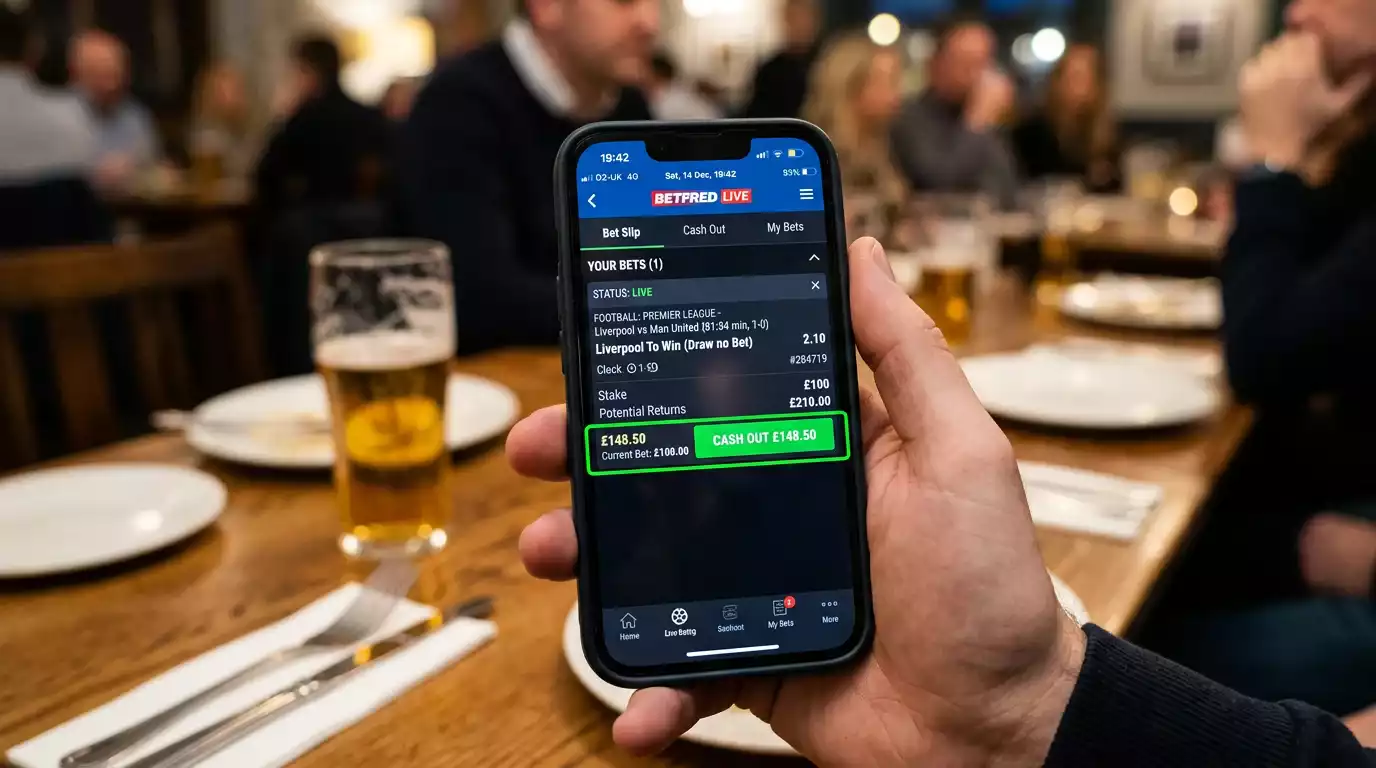
I have tapped the cash-out button on a UFC bet too many times. I have also refused to tap it and watched a sure win evaporate in the third round of a five-rounder. The cash-out is the most psychologically loaded button on any sportsbook interface, and the maths behind it is rarely as friendly to the punter as the interface suggests.
The button is the operator’s product wrapped in a frame that looks like yours. Understanding the maths underneath it changes whether you use it sparingly as a discipline tool or compulsively as a comfort blanket.
Use cash out alongside MMA live in-play betting for maximum control.
How the Cash-Out Price Is Calculated
The cash-out price is a function of three inputs: the original stake, the original odds at which the bet was placed, and the current live odds on the same outcome.
The mechanic is straightforward in principle. If you backed Fighter A at decimal 3.00 for ten pounds pre-fight, and Fighter A is now leading after round one with live odds of decimal 1.80 to win, the operator calculates the cash-out value as follows. Your original stake commits you to a thirty-pound payout if A wins. The operator could hedge that exposure now by laying a bet at the current 1.80 price that, combined with your slip, locks in a settlement. The cash-out value is essentially what the operator would pay you to exit the bet now.
The fair-value cash-out would be your original stake (10 pounds) divided by the current implied probability (1/1.80 = 55.6 per cent), giving roughly 18 pounds. The operator does not pay fair value. The operator pays the fair value minus a cash-out margin, which typically sits between three and six per cent on top of the live-line margin already embedded in the displayed odds.
So your actual cash-out offer on the same bet would be closer to 17 pounds. The operator has taken about a pound out of the fair value to compensate itself for offering the cash-out option at all. Across a year of slips where you take cash-outs regularly, that pound per cash-out adds up.
The Two Situations Where Cash-Out Earns Its Place
There are two scenarios where cash-out genuinely makes sense, and I will defend both of them.
The first is bankroll discipline on a long-shot win. You backed an underdog at decimal 5.50 for a meaningful stake, and the underdog has won round one cleanly. The remaining variance — the favourite recovering, the underdog getting clipped in round two — is meaningful even at the new live price of decimal 2.10. Taking a partial cash-out that locks in roughly the original stake plus a modest profit is a discipline move. You are not maximising expected value. You are reducing variance because the absolute size of the potential loss exceeds your bankroll’s tolerance for it.
This use case requires honesty. If the stake is small relative to your bankroll, the variance is not a problem and the cash-out is just an emotional response. If the stake is large enough that a loss would meaningfully damage your bankroll, the cash-out is bankroll management. The honest distinction is the one that determines whether the button is a tool or a leak.
The second is the structural-change scenario. The fighter you backed has just absorbed a knee that has clearly broken something. The live engine has priced the new state of the bout, but it has also widened the margin to compensate for uncertainty about the next few minutes. Your read is that the engine is correct on direction but slightly conservative on magnitude. Cashing out at the current price gives you partial settlement before the engine fully resolves the situation. This is a rarer use case, but it does come up.
Outside these two situations, cash-out is the operator’s product more than yours.
The Three Situations Where Cash-Out Costs You
The patterns of cash-out abuse are recognisable, and naming them is the first step to avoiding them.
The first is the relief cash-out. The fight is close. You are nervous. The button is right there. The price offers you about 70 per cent of your potential winnings. Taking it feels like relief. The maths is that you are paying the operator a meaningful chunk of expected value for the emotional comfort of certainty. Over a year of slips, the relief cash-outs are the single largest leak in a UFC punter’s portfolio.
The second is the panic cash-out. Your fighter has just lost a round. The live odds have shifted against you. The cash-out offers you 30 per cent of your stake back. Taking it locks in a substantial loss that may not have happened — the empirical record on UFC bouts where a fighter loses round one but wins the fight is around 18 per cent, depending on weight class and stylistic matchup. Panic cash-outs convert recoverable bets into certain losses.
The third is the chase cash-out. You have already lost the early bets on the card. You are down on the night. A live cash-out option appears for a bet you would not have taken pre-fight. The operator offers you a small certain win on a bet you should not be in. Taking it is the chase pattern in slow motion. Across a year, chase cash-outs are the second-largest leak after relief cash-outs.
Recognising the emotional driver behind each cash-out tap is the discipline that separates punters who use the button surgically from punters who pay the operator for it weekly.
Partial Cash-Out: The Compromise Option
UK sportsbooks increasingly offer partial cash-out — settle part of the slip now, leave the rest running. The interface lets you select a percentage of your stake to cash out, with the remainder continuing on the original odds.
Partial cash-out is the most defensible version of the product. It allows you to take some certainty without giving up all the upside. If your fighter is winning round one and you want to lock in the original stake, you can partially cash out the equivalent of your stake’s value while leaving the potential profit running. If the bout completes in your fighter’s favour, you collect both the partial cash-out and the remaining slip’s win. If it does not, you have already secured the stake.
The catch is that the cash-out margin still applies to the partial portion. The operator does not give you a free hedge. The partial cash-out has the same three-to-six per cent margin embedded as the full cash-out, applied to the cashed-out portion. The expected value of the slip is still negative compared to letting the bet run, but the variance is lower.
I use partial cash-outs sparingly and only in the discipline scenarios above — large stakes relative to bankroll, structural change in the bout’s state. The product has its place. The place is not every fight.
Bet Builder and Multiple Cash-Outs
Cash-out on multiples and bet builders has additional structural quirks worth knowing.
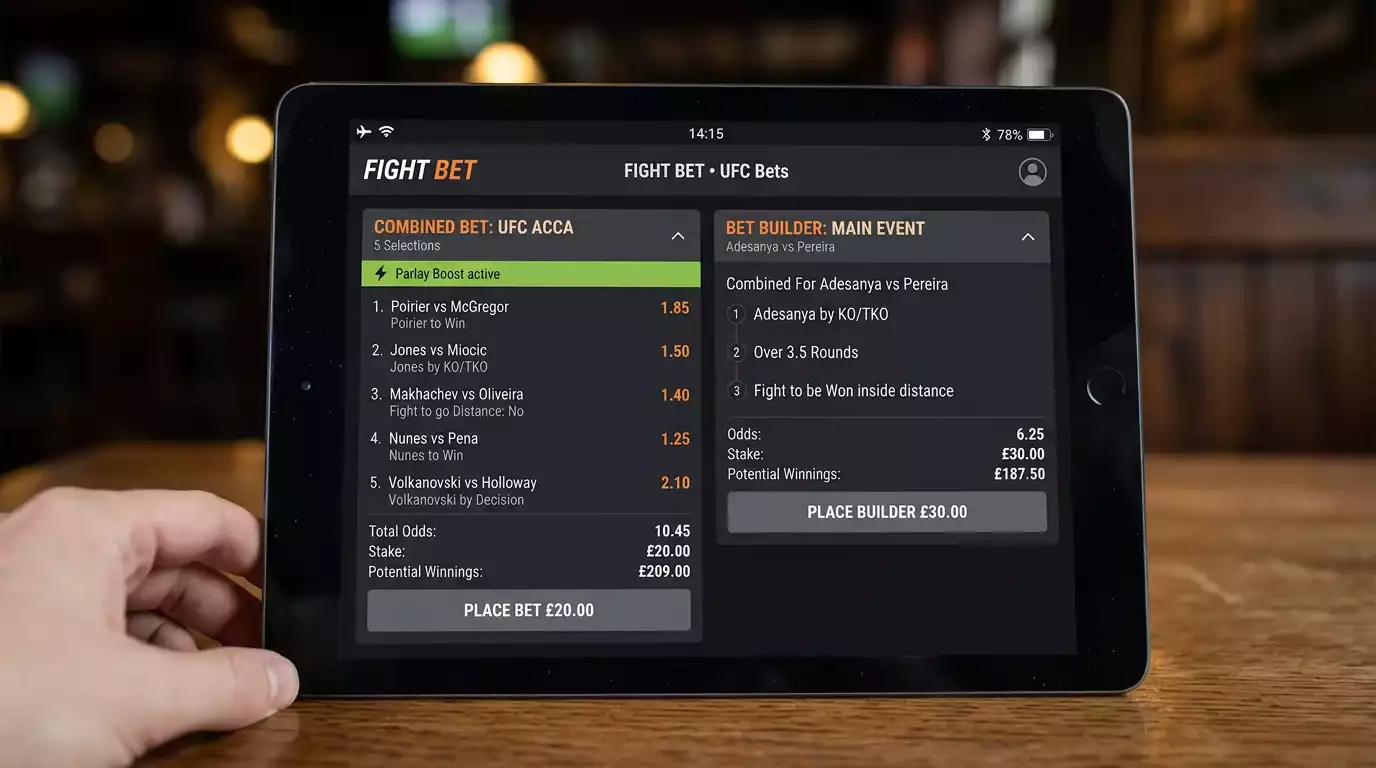
On a multiple where one or more legs have already settled, the cash-out price reflects only the unsettled legs. If four of five legs have landed and the fifth is in progress, the cash-out value sits close to the potential full payout multiplied by the implied probability of the fifth leg. Operators sometimes offer favourable cash-outs in this scenario because the certainty of the four settled legs reduces their hedging cost.
On a bet builder — multiple legs on a single fight — cash-out is more complex. The legs are correlated, the engine is pricing the correlation, and the live cash-out price reflects both the current state of the fight and the residual correlation of unresolved legs. Cash-out values on builders typically embed wider margins than cash-outs on traditional multiples because the engine’s uncertainty is higher.
If you want to understand the underlying mechanics of how legs interact in a bet builder more thoroughly, the deeper read is in my walkthrough of UFC bet builder construction.
UK Operators and Their Cash-Out Variations
The mechanic of cash-out is uniform across UK sportsbooks. The implementation differs. Three structural variations matter when you choose where to place a bet you may want to cash out later.
The first is auto-cash-out. Some operators let you set a target value at which the bet will automatically settle. The convenience is genuine. The downside is that auto-cash-out fires the moment the target is reached, even if subsequent action would have raised the cash-out value further. Use it for absolute discipline rather than optimisation.
The second is the cash-out availability window. Most UK operators offer cash-out from market open through to the final minute or two of the bout. Some narrow the window earlier, suspending cash-out in late round three on three-round bouts or late round five on five-rounders. The narrowing protects the operator against arbitrage during the highest-uncertainty period.
The third is the cash-out margin transparency. Some operators display the current potential return alongside the cash-out offer, making the gap between full settlement and cash-out value visible. Others display only the cash-out value. The difference is informational — you can calculate the margin in either case, but the displayed gap is the friction the operator wants between you and the temptation to use the button.
The UKGC consumer-protection wrap interacts with these variations. The mandatory deposit-limit prompts before first deposit and every six months, combined with the regulator’s record of over four per cent of UK accounts being restricted on commercial grounds, sit alongside cash-out as part of the broader behavioural-friction infrastructure. Cash-out is structurally a behavioural feature dressed as a financial product. The regulator treats it accordingly.
Explore betting mma for real-time UFC wagering tools.
How I Now Approach the Button
Three rules sit behind every cash-out decision I make.
The first is to ask whether the situation has materially changed since I placed the bet. If yes, cash-out is on the table. If not, the bet is still the bet, and tapping the button is just paying the operator for a feeling.
The second is to ask whether the absolute size of the potential loss exceeds my bankroll’s tolerance for it. If yes, partial cash-out for bankroll discipline. If not, let it run.
The third is to ask whether I am in the bet for variance management or for expected value. If for variance, the cash-out has a defensible role. If for expected value, the cash-out almost always damages the position.
Three questions. Three honest answers. The button is rarely the right choice when all three answers point in its direction.
For the natural next read, my walkthrough of parlay versus bet builder on UFC cards continues the analysis at the next layer of detail.
Is taking a cash-out always worse than letting the bet run?
No, but it is almost always worse on expected value. The cash-out price embeds an additional three to six per cent margin on top of the live-line margin, so the implied probability of the cash-out offer is systematically worse than the implied probability of letting the bet settle. The cases where cash-out is defensible are bankroll discipline on large stakes relative to your bankroll, and structural changes in the bout state that meaningfully shift the underlying probability. Outside those cases, taking cash-outs steadily costs more than it returns over a year of slips.
Can I cash out partway through a fight if the live market is suspended?
No. Cash-out availability tracks live market availability — if the live market is suspended for a knockdown, a near-finish, or a between-rounds break, the cash-out button is unavailable for the same window. The cash-out value resumes when the market reopens, but the price at that point reflects the new state of the fight, which often means the cash-out value has moved significantly from where it was when the action paused. Operators do this to protect themselves from arbitrage during the highest-uncertainty seconds of a bout.
Published by the Betting mma team.