Parlay versus Bet Builder: The Economics of Combining UFC Legs
 Available in US
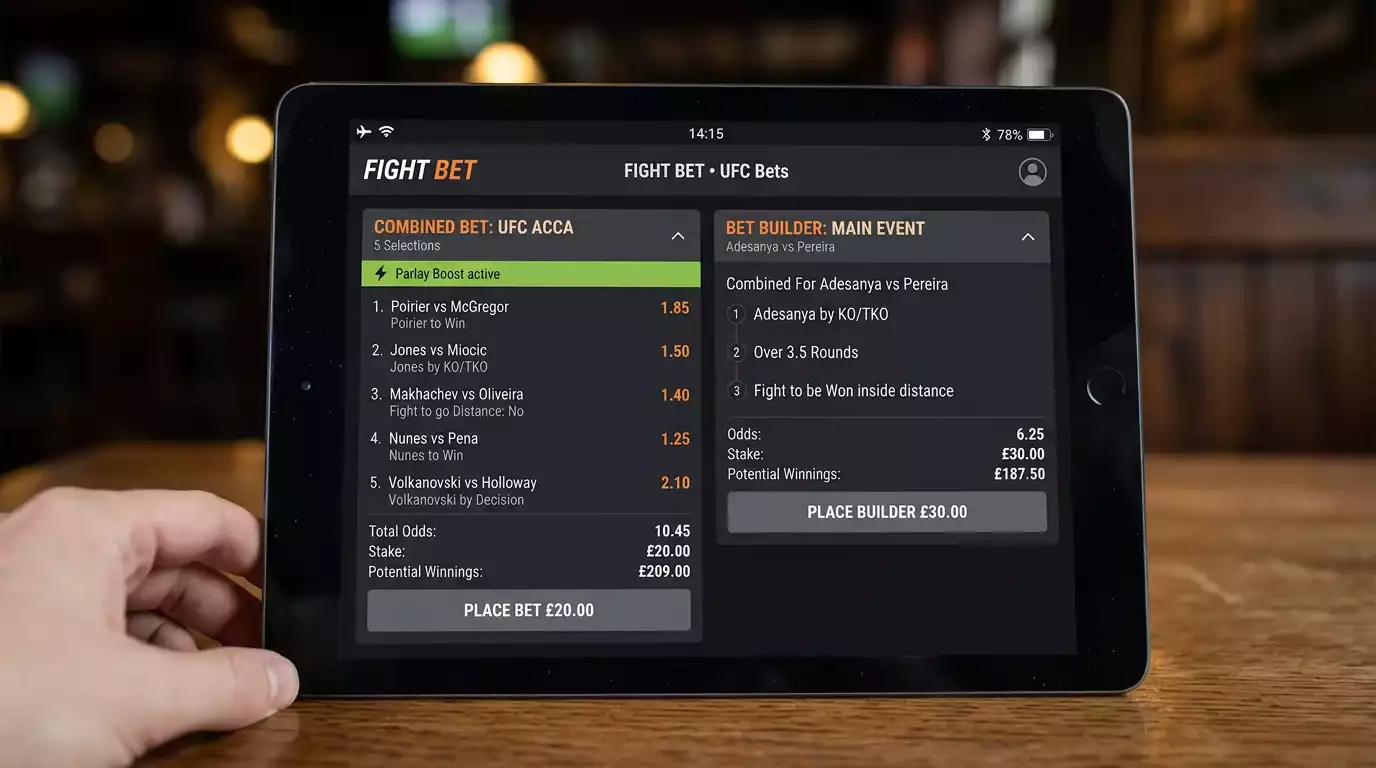
If I had a pound for every time someone asked me whether a parlay or a bet builder is the better way to combine UFC legs, I could fund a year of stakes from the answers alone. The honest response is that they are different products solving different problems, and the punter who treats them as interchangeable is paying margin twice.
The structural distinction is simple. A parlay (or accumulator, as it gets called in UK shorthand) combines legs across separate events, treating each as statistically independent. A bet builder combines legs inside a single event, where the legs are almost never independent. The operator’s pricing engine treats them entirely differently, and the punter’s expected value differs by a margin that matters.
Protect your parlays with UFC acca insurance offers from UK bookmakers.
The Independence Question
Combining bets multiplies probabilities. If you back three separate UFC fighters at decimal 2.00 each, the combined parlay pays decimal 8.00 if all three land. The maths assumes the three outcomes are independent — the result of fight one tells you nothing about the result of fight two.
That assumption holds cleanly for legs across separate bouts on the same card. Fighter A beating opponent A in the opening prelim is statistically unrelated to Fighter B beating opponent B in the headliner. The legs are independent in any practical sense, and the parlay maths reflects that independence by multiplying the prices directly.
The assumption breaks for legs inside the same bout. If Fighter A wins by KO in round one, every other leg on that fight — fight not to go the distance, under 1.5 rounds, A by KO/TKO — is essentially the same outcome with different labels. The legs are not independent. They are mathematically redundant.
The operator’s pricing engine knows this. The parlay engine multiplies prices freely on cross-event legs. The bet builder engine compresses prices on within-event legs to remove the redundancy. Punters who do not understand the distinction will sometimes try to build a “parlay” of three legs on a single fight, find the price suspiciously generous, and lose to the fact that the bookmaker has not yet processed the slip correctly. More often, the operator simply blocks the construction and forces the punter into a bet builder.
How a Parlay Prices
A four-leg UFC parlay across four separate bouts at decimal 2.00 each prices at decimal 16.00. That is the clean multiplication. The operator applies a margin to each individual leg — typically four per cent on a sharp UK book for moneyline legs — and the margin compounds across the multiplication.
The compounded margin is the practical drag on parlays. Four legs at four per cent margin each gives a combined margin of roughly 17 per cent on the multiplied price. The displayed 16.00 represents a true probability of about one in 19.2 rather than the one in 16 implied by independent multiplication. The four per cent that disappeared into margin on each leg compounds into a meaningful drag on the parlay price.
The drag is one reason parlays are popular with operators and unpopular with sharp punters. The price looks generous — 16/1 on four small-edge legs feels like a way to extract real upside from picks that individually pay little — but the compounded margin gives the operator close to twice the take of a single moneyline bet. Across a year of slips, parlays underperform single bets on the same picks by a meaningful margin precisely because the margin compounds.
The genuine use case for parlays is when each leg carries an edge. Four legs at decimal 2.00 with a five per cent personal edge each combine to roughly a 22 per cent combined edge net of compounded margin. That is still real value, and parlays are one of the few ways to scale a multi-bet edge without scaling stake size per leg, which can attract operator restrictions. The strategy works when the edges are genuine. It fails when the legs are filler chosen to make the price look prettier.
How a Bet Builder Prices
A bet builder on a single UFC bout looks like a parlay in interface terms but is priced through an entirely different engine. The engine assesses each leg’s correlation with the other legs and adjusts the combined price to reflect the joint probability rather than the multiplied price.
The mathematical foundation of strikes versus method illustrates the point. Significant strike differential is one of the cleanest predictors of method-of-victory outcomes in UFC. Fighters with positive differentials above 1.5 systematically out-finish the field. A builder that combines a winner leg with a no-distance leg with a fight-to-end-in-rounds-one-or-two leg is layering three outcomes that share the same underlying driver. The engine prices the correlation back into your odds.
Concrete numbers. Three legs on a single bout: A to win at 1.40, A to win by KO/TKO at 2.20, fight not to go the distance at 1.60. Multiplied naively: 4.93, or 4/1. The builder engine prices the joint outcome closer to 2.30 or 2.50, depending on the specific operator and the engine’s correlation model. The compression is roughly half the naive multiplication, and the half that disappeared is the correlation tax.
The correlation tax is fair in the sense that the legs really are redundant — if A wins by KO, all three legs land together by definition, and the joint probability is closer to the highest individual probability than to the product of the three. The tax is unfair only in the sense that the operator is the one calculating it and embedding margin in the calculation. The honest builder works because the operator’s correlation model is not perfect, and reads on specific matchups can identify cases where the model overstates correlation more than the data justifies.
The deeper read on how I approach builder construction across method, round and prop legs is in my walkthrough on building UFC bet builders.
Where Parlays Beat Builders
Cross-event combinations on UFC cards are the clean territory for parlays. Four ranked fighters on four separate bouts, each with a real edge, combine cleanly into a parlay because the legs are genuinely independent.
The discipline is in leg quality. A parlay is a multiplication of edges, but it is also a multiplication of losing probabilities. Four legs at 60 per cent each combine into a 13 per cent combined hit rate, even though each leg is a likely winner. The variance is high. The hit rate is low. The price compensates if the edges are real.
Parlay insurance — the standard UK promo that refunds stakes when exactly one leg loses — changes the maths for parlay use specifically. The refund tilts the expected value calculation in the parlay’s favour for slips with the right structure, but only marginally and only when the qualifying conditions match the slip you would have built anyway. The deeper read on the insurance mechanism is in the dedicated walkthrough.
The other clean parlay territory is mixing UFC with non-UFC sports. A UFC parlay leg combined with a Premier League goalscorer leg and a tennis set winner leg is a parlay across genuinely independent events with no correlation worth pricing. The compounded margin still drags, but the independence is real, and the parlay maths is honest.
Where Builders Beat Parlays
Single-fight specialist reads are the clean territory for bet builders. If your read on a specific bout is detailed enough to support three or four interlocking conclusions — fighter A will win, will win inside the distance, will win by KO/TKO, will win in rounds one or two — the builder lets you express that compound conviction in one slip with one stake.
The compression hurts. The expected value is below the naive multiplication. But the builder lets you put proportionally more capital onto a single fight without the cross-event variance of a parlay. If your strongest read on the card is one specific bout, a builder gives you the maximum exposure to that read without scaling stake size in ways that attract operator restrictions.
The builder also handles void scenarios more cleanly than parlays in many cases. A single voided leg in a parlay reduces the multiplication and recalculates the combined price. A single voided leg in a builder typically voids the entire builder, which is structurally fine because the builder is a single bet on a single event. The simplicity matters when you are running multiple slips and need to know exposure clearly.
The Multi-Builder Approach
A pattern I have used increasingly across 2025 and into 2026 is the multi-builder — combining multiple bet builders, each on a separate bout, into a single parlay slip. The legs of the parlay are full builders rather than individual bets, and the parlay engine treats the builders as independent because they are on different bouts.
The maths is interesting. Each builder has been compressed by the correlation tax inside its own bout. The parlay engine then multiplies the compressed builders cleanly because the cross-bout correlation is zero. The combined price reflects the within-bout compression but escapes the across-event compounding penalty.
The downside is variance. Each builder needs to land for the parlay to pay, and the hit rate on builders is structurally lower than on single bets. A four-builder parlay where each builder cashes at 30 per cent gives a combined hit rate of less than one per cent. The price on the slip will look spectacular. The actual return over a year of these slips is dominated by the variance.
Used sparingly, the multi-builder is a tool for expressing high-conviction reads on multiple bouts simultaneously. Used routinely, it is the operator’s product more than the punter’s, and the margin compounds in the same way as on a standard parlay.
See also: betting mma for multi-bet MMA strategies.
The Discipline of Choosing One
The structural decision before placing any combined slip is which product fits the read.
If the read is across multiple bouts with independent edges, the parlay is the right product. Accept the compounded margin as the cost of scaling the multi-edge.
If the read is one detailed conviction on a single bout, the builder is the right product. Accept the correlation tax as the cost of expressing the compound view.
If the read is partial across multiple bouts but full on one, a single bet on the full read plus a separate parlay on the partials is often cleaner than trying to combine them into one slip.
The product that fits the read is the product that returns the most expected value. Picking the product that looks prettiest on the slip is how operators earn the second margin tier on UFC combined betting. The punter who chooses the product to fit the read pays one margin. The punter who chooses the product for excitement pays it twice.
For the natural next read, my walkthrough of prelims versus main card value continues the analysis at the next layer of detail.
Can I build a parlay using only legs from a single UFC bout?
No. Operators block parlay construction on multiple legs from the same bout because the legs are not independent, and the parlay engine cannot price them correctly. The required product for combining legs on a single bout is the bet builder, which uses a correlation-aware pricing engine. If you try to add a second leg from the same fight to an existing parlay slip, the interface will typically redirect you to the bet builder or refuse the combination outright. The refusal is the operator protecting itself from offering uncorrelated multiplication on correlated outcomes.
Why does my bet builder price seem so much lower than multiplying the individual leg prices?
Because the legs on a single fight are correlated, and the bet builder engine compresses the combined price to reflect the joint probability of the outcomes occurring together. A builder that combines a winner leg with a no-distance leg and a KO/TKO method leg is layering three outcomes that share the same underlying driver — if the fighter wins by KO, all three legs land simultaneously by definition. The engine prices the correlation back into your odds rather than letting the naive multiplication compound. The compression is typically between 30 and 60 per cent of the naive multiplied price, depending on the strength of correlation across the chosen legs.
Created by the ”Betting mma” editorial team.