Prelims versus Main Card: The Hidden Value Below the Headliner
 Available in US
Most casual UFC punters wake up on a Sunday morning, scroll to the headliner result, place three bets on the main card, and call that engagement with the sport. I have spent the last several years working backwards from that pattern. The prelims — the unranked fights, the regional newcomers, the matchups buried at the bottom of the broadcast — are where the operator’s pricing model is weakest and where reading a fighter carefully produces edges that simply do not exist on the main card.
The trade-off is the volume of work for the size of the edge. A main-card fighter has eight previous UFC fights, hours of broadcast footage, and a pricing model that has converged on his real ability. A prelim fighter on his third UFC bout has three priors, an inconsistent record at regional level, and a pricing model that is still finding his actual probability against UFC-calibre opposition.
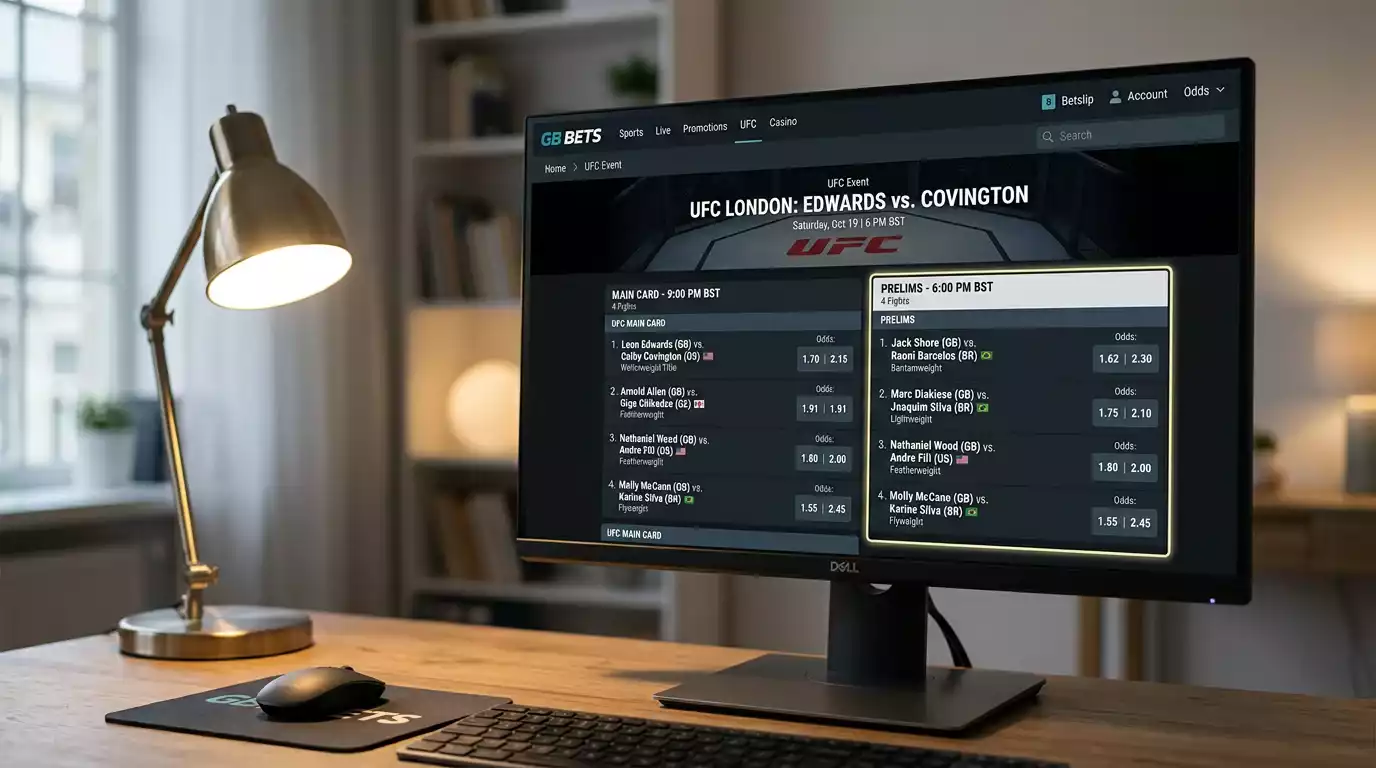
Spot UK fighter value at UFC London events across all card positions.
The Information Gap on Prelims
Operators price UFC fights using internal models that are well-calibrated for ranked opponents and increasingly noisy as you move down the card. The model relies on UFC strike data, takedown data, control data, and outcome data. For a fighter with eight UFC bouts, that dataset is rich. For a fighter with three UFC bouts on the back of a regional record, the dataset is thin and the model leans heavily on assumptions about how regional performance translates.
The translation is the gap. A fighter who finished six of seven regional opponents in his Cage Warriors or LFA run may continue that pace against UFC opponents, or he may stall. The model gives a baseline probability based on average translation rates. A punter who has watched the regional footage knows whether the finishes came against fighters who would compete at UFC level or against bottom-rung opposition that would not.
The same gap operates in reverse. A UFC veteran on a four-fight losing streak in the prelims may look like a fade on paper but is the kind of seasoned operator who knows the system well enough to extend a fight against an inexperienced newcomer who is still learning to read the moment. The model captures the losing streak. The model does not capture the experience gap, which on certain matchups is the real predictor.
The sharper UK books carry roughly six to seven per cent margin on prelim moneylines, against the four per cent margin on main events. The wider margin is the operator pricing in its own uncertainty. The wider margin is also the territory in which a punter who has done the work has more room to identify real value than on the tighter main-card lines.
Where Prelim Edges Cluster
Five categories of prelim edge come up consistently enough to be worth listing.
The first is the regional-feeder graduate. A fighter who has run through Cage Warriors with finishes, has the matchups studied, and arrives in the UFC with a style that translates cleanly. The line tends to underprice these fighters because the model treats them as generic newcomers. Watching the regional footage takes 90 minutes and produces a read worth backing.
The second is the experience asymmetry. A UFC veteran in his 12th UFC bout against a newcomer in his second. The line reflects records and recent form. It does not reflect the gap in cage management, in dealing with hostile crowds, in pacing a five-round bout that does not need finishing. The veteran’s edge is structural rather than statistical.
The third is the style mismatch buried below the headliner. The matchmakers sometimes build prelims for entertainment rather than competitive balance — a known striker against a known grappler with poor takedown defence, for example. The fight is genuinely lopsided in one specific direction. The line is sometimes slow to price the full lopsidedness, especially on the method side of the menu.
The fourth is the late replacement on a prelim. Late notice fighters with under ten days’ preparation show positive return on investment when priced above the favourite line, especially in round one finishes. The pattern holds across a three-year sample. Prelims see more late replacements than main cards because the matchmakers cannot rebuild a main card on short notice, so the swaps cascade down to the openers.
The fifth is the women’s prelim where the operator model is sparsest. UFC women’s matchmaking sometimes draws from a thinner regional pool than the men’s side, and pricing on early women’s bouts can lag the structural matchup. The deeper read on the women’s divisions specifically is in my walkthrough of betting UFC women’s divisions.
The Main Card: Why Prices Are Sharper
The main card is where the operator’s model is most accurate, the public’s money is heaviest, and the sharp money is most engaged. The combination tightens the line in the 24 hours before the card.
Main-event moneyline margins at sharp UK books sit close to four per cent. The line moves are smaller in absolute percentage than prelim line moves but more meaningful in informational terms — a half-point move on a main event signals real money on one side. The integrity wrap is most active on main events because the betting volume is highest. The 2025 Dulgarian and 2026 Johnson cases that defined the modern integrity discussion both involved bouts on cards where the integrity service flagged unusual line moves before the cage opened.
Headline numbers from recent cards illustrate the scale. UFC 326 in March 2026 drew a peak audience of 3.21 million on CBS during its broadcast minute, with a two-hour average of 2.47 million viewers. Those numbers represent the betting volume the main-card markets need to clear, and the sharpness of the main-card pricing reflects that volume. A line on a UFC 326 main-card bout has been worked over by every model and every sharp punter willing to engage with it. The price reflects that work.
The sharper the line, the harder the edge. The historical UFC win rate on heavy favourites between minus 400 and minus 900 sits between 88 and 93 per cent across the OddsTrader dataset, and that band is overwhelmingly populated by main-card fighters. The market gets these prices broadly right. The edge available to a punter on a main-event heavy favourite is small to zero, and the operator’s commercial-restriction policy makes grinding that band over time difficult anyway. Over four per cent of UK accounts have been restricted on commercial grounds, the regulator’s data shows, and the accounts restricted are disproportionately those that grind heavy main-card favourites.
The main card rewards reading the slight favourites in the minus 122 to even price band, where empirical win rates sit close to coin-flip 51 per cent and the operator’s lean is more sensitive to public money. The deeper walkthrough of how moneylines work across different price bands is in my moneyline market explainer.
The Time Allocation Question
An honest UFC card has 12 to 14 fights. Working all of them in equal depth is impossible for any punter not doing this full-time. The allocation question is how to split time across the card.
The split I have settled on is roughly 50 per cent of preparation time on prelims, 35 per cent on the lower main card, and 15 per cent on the headline bout. The percentages invert the broadcast hierarchy because they reflect where edge actually lives.
The headliner is the fight everyone has prepared for. The line is tight. The public sentiment is loud. The integrity wrap is most active. The edge available is structural rather than informational — a sharp moneyline read, perhaps, or a method-bucket read based on a stylistic mismatch the public has underweighted. Most main events resolve through their pre-fight expected probability, and the punter chasing main-event-only bets is paying the tightest margin in the market.
The lower main card is where ranked fighters meet ranked fighters and the line is sharp but not tight. The integrity wrap is active but less intense. The public money is moderate. The lines move on injury news and weigh-in events more than on public sentiment. Edges exist for punters with style reads and access to fighter information beyond the broadcast pre-fight package.
The prelims are where the operator’s model is weakest, the public is least engaged, and the punter who has done the work has the most informational advantage. Two or three carefully chosen prelim bets per card consistently outperform a comparable stake spread across the main card, in my experience and across the punters I have compared notes with.
The Risk Profile Differs
Prelim bets carry different risk characteristics than main-card bets.
The first difference is cancellation risk. Prelims see more late replacements, more weigh-in misses, more late-window pull-downs. The 2025 and 2026 calendar produced several high-profile prelim cancellations that left punter slips voided and refunded. Cancellation risk on a prelim is structurally higher than on the headliner.
The second difference is variance. Prelim fights produce higher variance outcomes than main events. A newcomer’s third UFC bout can resolve as a one-punch knockout, a grinding decision, or anything in between. The empirical variance is wider, the price range is wider, and the standard deviation of returns is higher per pound staked.
The third difference is the integrity wrap. Prelims are not exempt from integrity monitoring, but the focus is comparatively lower than on main events. Late line moves on prelims have, in some cases, signalled integrity issues that resolved into bout cancellations. The 2025 Dulgarian case involved a co-main event rather than a true prelim opener, but the pattern — unexplained line move, integrity flag, pull-down — has appeared on prelim bouts too.
The fourth difference is media coverage. Prelim fighters get less broadcast attention pre-fight, fewer media days, and less footage available to punters preparing. The information gap that creates the edge is the same information gap that increases the risk of misreading a fighter who has a hidden injury, a difficult weight cut, or a camp dispute that has not made the press.
See also: betting mma for card-level UFC analysis.
How I Approach the Cards Now
The approach I have settled into is to prepare the prelims first, lock in two or three prelim bets where the read is clear, and then approach the main card with the prelim work as context rather than as the central focus. The structure produces more cards where the prelim bets pay than the main-card bets, and the cumulative return over a year is meaningfully better than the inverse allocation.
The discipline is to resist the gravitational pull of the headliner. The headliner is the most exciting fight on the card. It is also, statistically, the fight where the operator’s margin is smallest, the public’s money is heaviest, and the punter’s edge is most compressed. Backing the headliner is rarely the worst bet on the card. It is rarely the best one either.
Why are prelim moneylines often wider than main-event moneylines?
Because the operator’s pricing model has less data on prelim fighters than on ranked main-event veterans, and the wider margin compensates for that uncertainty. Main-event moneylines at sharp UK books typically sit at roughly four per cent margin, while prelim moneylines often run six to seven per cent. The wider margin gives the operator more room to be wrong about the underlying probability. The same wider margin gives the informed punter more room to be right against the line, which is one of the reasons prelim reading consistently outperforms main-card-only betting over a year of slips.
Are prelim fights more likely to be cancelled than main events?
Yes, marginally. Prelims see more late replacements and more weigh-in misses because the matchmakers cannot rebuild a main card on short notice and the schedule cascades adjustments down to the openers. Recent UFC calendars have produced several high-profile prelim pull-downs alongside the better-known main-event cancellations like the 2025 Dulgarian case. Cancellation risk on prelims is structurally higher per bout, though main-event cancellations get more press when they happen. Refund treatment is standard across both categories — full stake refund on the cancelled fight, with multiples having the affected leg voided and the rest of the slip recalculating.
Written by the editors at Betting mma.