Cage Warriors and the UK Feeder Card Betting Edge
 Available in US
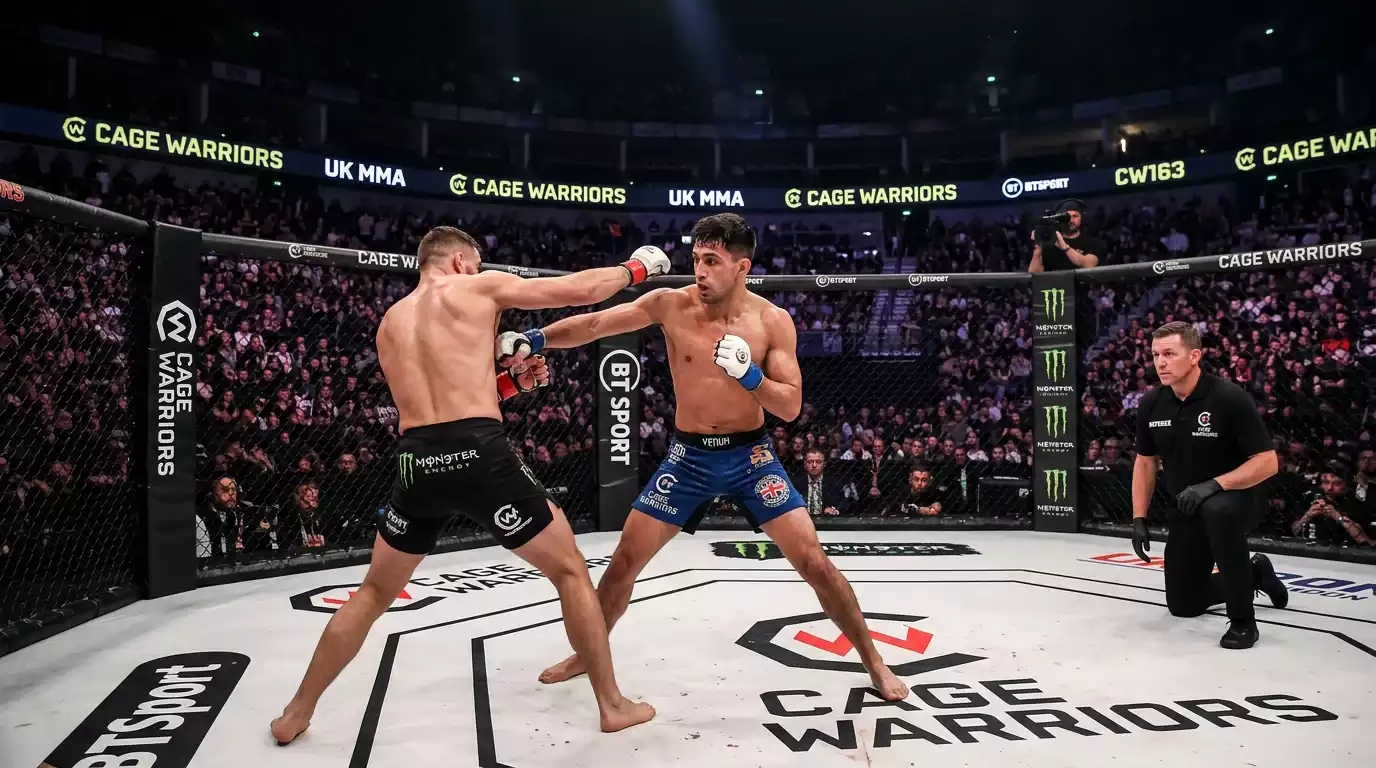
Most of the punters I talk with about UFC betting have never placed a single bet on a Cage Warriors card. They have heard the name. They know the promotion feeds fighters to the UFC. They have seen the headline alumni — Conor McGregor, Paddy Pimblett, Joanne Wood among many others — graduate to the larger stage. What they have not done is built a betting routine around the regional feeder cards, and that gap is one of the cleanest unexploited edges in the broader UK MMA market.
The mechanism is straightforward. Operator models on UFC cards are tight. Operator models on regional feeder cards are loose. A punter who watches the regional cards is reading fighters at a level the model has barely begun to process. The variance is real. The edge is also real.
See how prospects fare once they reach UFC women’s divisions betting.
What Cage Warriors Is
Cage Warriors is the headline UK regional MMA promotion, running cards primarily in the UK and Europe with belts across the standard weight classes. The promotion has built its reputation as the feeder route into the UFC for UK and Irish fighters, with a track record of champions graduating to the upper organisation. The matchmaking is competitive at the championship level and inconsistent at the lower tiers, which is a feature for the punter rather than a bug.
The betting markets on Cage Warriors cards are offered by most UK sportsbooks, though typically with narrower menus than UFC cards. Moneyline, method of victory in three buckets, over/under rounds, and the fight-to-go-the-distance binary are usually available. Bet builders are available on champion-level bouts but often not on the openers. Round-by-round markets are rare. Prop markets are usually absent.
The narrower menu is the operator’s response to thinner liquidity. The same operators that quote eight or ten markets on a UFC prelim quote only four or five on a Cage Warriors championship fight, and they widen the margin to compensate for the smaller volume of money taking the prices.
Why the Operator Model Is Weaker Here
Three structural reasons make operator models weaker on Cage Warriors than on UFC.
The first is the data layer. UFC cards are tracked through extensive in-cage statistics — significant strikes, takedown attempts, control time, head-to-head matchups at the same weight, ageing curves on individual fighters. Cage Warriors cards are tracked with much thinner statistical infrastructure. Operators rely partly on win-loss records, partly on broadcast tape, and partly on translation models that adjust regional performance to expected UFC equivalent. The translation models are imperfect.
The second is the matchmaking pattern. UFC matchmakers build competitive bouts at the high end and lopsided bouts at the bottom of the card to give returning veterans wins. Cage Warriors matchmaking is more variable. Championship bouts are usually competitive. Mid-card bouts sometimes feature a developing fighter against a regional journeyman whose record overstates his current ability. The operator’s model captures the won-lost record but not the underlying decline curve, and the line on the journeyman is often shorter than his real probability against the developing fighter.
The third is the volume of public money. UFC cards attract heavy public money, and the line settles tight as a result. Cage Warriors cards attract lighter public money, mostly from regional UK punters with knowledge of the local fighters. The line moves less in response to public sentiment but also reflects less collective intelligence than a UFC line does. A punter with strong knowledge of the regional scene is competing against a softer line than on equivalent UFC bouts.
How I Build a Cage Warriors Card Read
The preparation routine for a Cage Warriors card differs from the UFC preparation routine.
Step one is to watch the previous two or three Cage Warriors cards in full. The fighter pool turns over more slowly than UFC — most of the fighters on the current card have appeared on at least one of the prior three cards. Watching the previous appearances builds the database the operator model is still constructing.
Step two is to identify the championship-level fighters and the developing fighters on the current card. The championship fighters are the closest to UFC-calibre and the most accurately priced. The developing fighters are where the model is weakest and the edge is widest. Mid-tier fighters — not contenders, not openers — sit in between.
Step three is to map style matchups across the card. A Cage Warriors developing striker against an opponent with poor takedown defence is the kind of matchup that produces a clean stoppage at a meaningful price. The operator’s model has the styles. It does not always weight them correctly given the smaller dataset.
Step four is to set unit sizes lower than the UFC equivalent. The variance is higher, the operator margin is wider, and the cancellation risk per bout is also higher because regional cards see more late replacements and short-notice withdrawals. Smaller stakes per bet, more bets per card, narrower exposure per slip.
For the deeper read on submission opportunities specifically, including how Cage Warriors matchmaking produces submission mismatches more often than UFC matchmaking, the follow-on is in my walkthrough of submission betting.
The Cage Warriors Submission Bet
The single market where Cage Warriors edges concentrate most reliably is the submission method bucket on developing fighters.
The mechanism is matchmaking. UFC matchmakers avoid pairing top submission specialists against fighters with takedown defence below 60 per cent because the bout becomes one-sided. Cage Warriors matchmakers sometimes build these matchups intentionally to showcase a developing fighter or to give a regional veteran a stoppage win. The line on the matchup prices the moneyline of the favourite but understates the submission probability specifically.
A developing BJJ specialist at decimal 4.00 to win, with an opponent whose takedown defence sits at 52 per cent across his recent regional bouts, is a different bet from the same moneyline on a UFC card. The UFC equivalent matchmaking would not pair these styles together at that gap. The Cage Warriors matchmaking did. The submission price on the BJJ specialist often sits at decimal 8.00 or longer, when the structural probability is closer to one in five or one in six.
The pattern recurs across roughly two or three Cage Warriors cards per year. The bets do not cash often — the variance is real — but the prices are wide enough that hit rates of 18 to 22 per cent across this category produce strong long-run returns. The discipline is to take the bets only where the matchmaking mismatch is genuine and the operator has not corrected for it.
The UFC Graduation Signal
Cage Warriors fighters who win belts or who run multiple-fight finish streaks tend to graduate to the UFC within 12 to 18 months. The graduation has betting implications both before and after.
Before graduation, the fighter’s last Cage Warriors bouts often feature heightened media attention from UK MMA outlets. The line tightens slightly because the public’s awareness of the fighter increases. The edge available on the fighter’s final regional bout is sometimes smaller than on his earlier ones, because the operator has reasons to focus its model on UFC-prospect fighters more carefully than on career regional fighters.
After graduation, the fighter’s first UFC bout is the highest-information window of his career. He has a regional record the public can see but the UFC matchmaking has chosen his opponent specifically. The operator’s model uses translation factors to price him against the UFC opponent. The translation can be wrong in either direction.
A Cage Warriors finisher who has run through soft regional opposition may translate to a 50/50 UFC bout against a ranked opponent. The public sometimes overprices the regional record. The line shortens. The sharp fade is the regional finisher when the UFC matchmaking has paired him above his actual level.
A Cage Warriors technical fighter who has won decisions against good regional opposition may translate cleanly to UFC level. The public sometimes underprices the regional record because decisions are less visible than finishes. The line stays longer than fair value. The sharp back is the technical regional fighter when his UFC debut comes against an opponent his style counters.
Tracking these graduations and their first UFC bouts is one of the highest-information disciplines available to a UK MMA punter, because the regional viewing pays off on the larger stage where the prices are richer.
The Risks of Regional Betting
Three risks are higher on Cage Warriors than on UFC.
The first is cancellation. Regional cards see more late replacements and more weigh-in misses. A bout you backed three weeks ago may feature different fighters by the morning of the card, with the original bet voided. Build cancellation tolerance into your slip planning.
The second is the integrity wrap variance. Cage Warriors and other regional UK promotions sit under the wider IBIA monitoring framework, but the resourcing is structurally lighter than on UFC cards. The 2025 IBIA data recorded 300 alerts across all sports, up 29 per cent from 232 in 2024, with 54 corrupted matches identified and 24 athletes sanctioned across five sports including one MMA athlete. The MMA case last year did not directly involve Cage Warriors, but the wider data point is that regional MMA produces more flagged events per fight than UFC does, and the per-card integrity profile differs.
The third is the operator’s response to your behaviour on regional cards. UK operators have restricted over four per cent of accounts on commercial grounds, the regulator’s data shows. Accounts that grind regional cards consistently can attract restriction faster than accounts that bet UFC main cards, because the operator views regional betting volume as more likely to come from sharp punters and less likely to be balanced by public money. Punters who develop a strong regional record sometimes find their stake limits cut without explanation. This is the operator’s right under its terms of service, and the regulator’s framing places these restrictions inside the commercial-decision category rather than the responsible-gambling category.
Explore betting mma for regional MMA coverage.
The Regional Calendar as a Long-Term Discipline
Cage Warriors and the wider UK regional scene are a long-term discipline rather than a casual hobby. The cards happen roughly monthly. The fighter pool turns over slowly. The edge per bet is small to moderate, the variance is high, and the cumulative return over a year of careful work is meaningful only for punters who commit to the routine.
The reward is twofold. The direct return on the regional bets, when the routine is followed and the discipline holds, exceeds the equivalent stake on UFC main-card betting by a meaningful margin across a year. The indirect return is the broader UK MMA literacy that informs UFC bets when the fighters graduate. The Cage Warriors fighter you watched in his last regional bout is the UFC fighter you have the sharpest read on six months later, when his first UFC line is published and the public is still catching up.
For the natural next read, my walkthrough of reading UFC coaching changes continues the analysis at the next layer of detail.
Are Cage Warriors fights covered by UK sportsbooks?
Most major UK sportsbooks offer markets on Cage Warriors cards, though typically with a narrower menu than UFC cards. Moneyline, method of victory in three buckets, over/under rounds and the fight-to-go-the-distance binary are usually available. Bet builders appear on championship-level bouts but rarely on the openers. Round-by-round markets and prop markets are mostly absent. The narrower menu reflects thinner liquidity, and the operator margin on Cage Warriors moneylines typically runs wider than the equivalent UFC margin to compensate for the smaller volume of money taking the prices.
Why is the operator margin wider on regional MMA than on UFC?
Because the operator’s pricing model has less data on regional fighters than on UFC fighters, and the wider margin compensates for that uncertainty. UFC fights are tracked with extensive in-cage statistics, while regional cards have thinner data infrastructure. The matchmaking patterns also differ, with regional promotions sometimes building stylistic mismatches that UFC matchmakers avoid. The combination produces a less-confident model, which the operator hedges through wider margin. The same wider margin gives the informed regional punter more room to find genuine value than on the tighter UFC lines.
Published by the Betting mma team.