Weight Cuts and the Betting Line: Reading the Hydration Window
 Available in US
Table of Contents
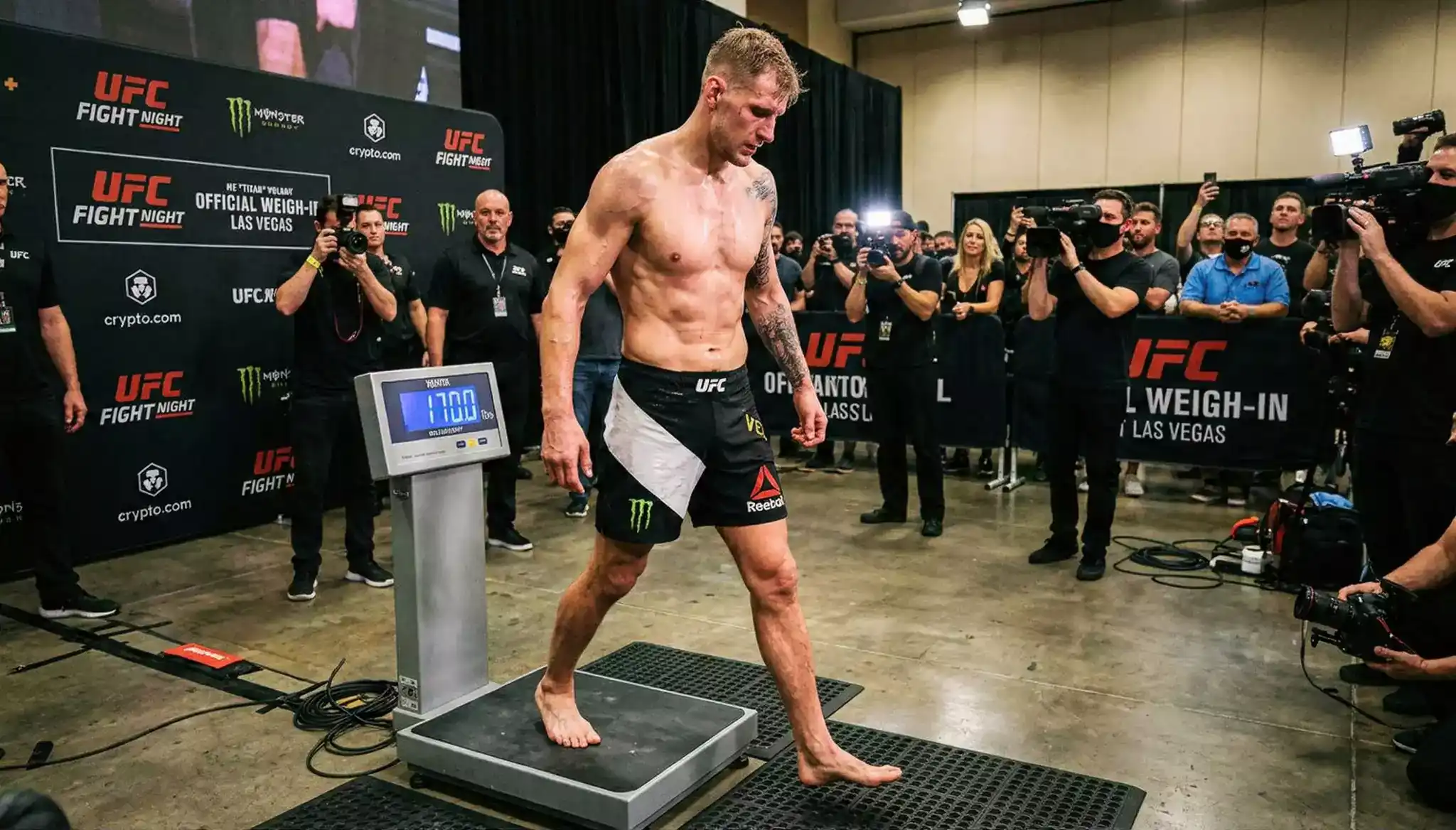
The most expensive lesson I ever learned in UFC betting came from a fighter who hit the scale at his contracted weight, then performed in the cage like a man recovering from food poisoning. The cut was extreme. The weigh-in photos showed it. The line did not. I had backed him at a price that assumed he would arrive at the cage in normal condition, and the empty tank in round two answered a question I should have asked before placing the stake.
Weight cuts are one of the worst-priced inputs to UFC outcomes. The market treats the scale reading as the binary signal — made weight or missed weight — and largely ignores the gradient of how badly a fighter cut to get there. The gradient is where the betting edge lives, and it shows up consistently enough across a season to be worth tracking carefully.
Why Weight Cuts Matter for Pricing
UFC fighters typically walk around between 10 and 25 pounds above their contracted fight weight. The cut to make weight involves a combination of dietary water reduction, sodium manipulation and active sweating in the 24 to 36 hours before the official weigh-in. Once the fighter hits the scale, he begins rehydrating for the bout, typically gaining back 12 to 20 pounds before the cage door closes the next evening.
The performance impact depends on how cleanly the cut was executed. A fighter who has rehearsed the cut multiple times, who has good camp infrastructure for it, and who hits weight without extreme last-day measures rehydrates effectively and arrives at the cage close to normal performance. A fighter who has struggled with the cut — multiple sauna sessions, last-hour weight stripping, dehydration extreme enough to show on his face — does not fully recover the cardio and reaction time he had in camp.
The cardio penalty is the largest single output. A compromised cut typically costs the fighter 15 to 25 per cent of his cardio capacity over a three-round bout, with the impact concentrated in round three. The reaction time penalty is the second-largest, costing 5 to 10 per cent of speed in the first round and increasing through the bout as fatigue compounds the dehydration recovery deficit.
The operator’s pricing model captures the scale reading. It rarely captures the cut quality. The information gap between the two is what the punter who watches weigh-in coverage can exploit.
What Weigh-In Footage Tells You
The official weigh-in for any UFC card is broadcast publicly the day before the event. The footage carries information the line has not yet processed, and a 15-minute careful viewing produces reads that the operator’s model misses.
Three visible signs of a bad cut consistently predict compromised performance the next night.
The first is the facial profile at the scale. A fighter whose cheeks are visibly sunken, whose eye sockets are deeper than normal, and whose jawline shows the bone clearly is dehydrated beyond the standard cut window. The face recovers partially after rehydration, but the underlying systemic stress does not. The deeper the visible sinking, the worse the cut.
The second is the stage demeanour. A fighter who walks slowly to the scale, who needs assistance removing his shirt, who steps onto and off the scale with visible effort is operating at the edge of his physical capacity at that moment. The recovery distance to fight-night condition is longer when the starting point is closer to collapse.
The third is the post-weigh-in rehydration speed. UFC fighters typically begin rehydration immediately after weigh-ins, with photos and brief media appearances showing them an hour or two later. A fighter whose colour returns quickly, who is making weight comments and walking normally within the hour, has recovered effectively. A fighter who still looks gaunt at the head-to-head face-off photo session three hours after weigh-ins has not. The gap between the official weigh-in moment and the face-off is one of the most informationally rich windows for late-line punters.
Missed Weight: The Direct Signal
A fighter who fails to make contracted weight is the most direct version of the weight-cut signal. The fight may continue at catchweight, with the missing fighter forfeiting a percentage of his purse to his opponent, but the cut was clearly mismanaged.
The line typically moves immediately on a missed weight announcement, with the opponent shortening by 10 to 20 per cent on the moneyline. The move is partly correct — a missed-weight fighter has demonstrated cut issues that usually correlate with performance issues. The move is also partly incomplete, because the line tends to settle before all the implications are fully absorbed.
The deeper analysis of how the line moves around weigh-ins specifically, including missed-weight scenarios, is in my walkthrough of weigh-in day line movement.
The empirical record on UFC missed-weight fighters across the recent calendar shows them winning roughly 35 to 40 per cent of their bouts at catchweight, against a baseline of 50 per cent for non-catchweight bouts at the same moneyline level. The 10 to 15 percentage point gap is the structural impact of the bad cut on performance, and it tends to hold across weight classes and stylistic matchups.
The market sometimes overshoots on missed-weight news, particularly on social-media-driven cards where the weigh-in is widely shared. The opposite trade — backing the missed-weight fighter when the line has moved too far against him — produces occasional value, though the variance is high and the discipline is to wait for moves of 20 per cent or more before considering the position.
The Hidden Cut: When the Scale Reads Cleanly
The harder signal to read is the fighter who makes weight officially but who has clearly cut hard to do so. The official weigh-in records the number. The footage records the condition.
The empirical pattern across UFC cards is that fighters making weight at the upper end of their contracted bracket — a lightweight hitting 155.0 instead of 154.5, for example — are more often making weight cleanly than fighters who hit the exact contracted limit on the second attempt after walking away to lose another half-pound. The two scenarios produce identical scale readings but very different cage conditions. UFC’s official scale records both attempts when a fighter needs to step off and step back on. The first-attempt reading versus the eventual reading is publicly available information that the line does not always price.
Weight Cuts and Method-of-Victory Pricing
The weight-cut signal shows up most clearly in method-of-victory markets, not in moneylines.
The mechanism is round-by-round performance degradation. A fighter with a compromised cut starts the bout near his expected performance level — reaction time slightly slower, but power and technique mostly intact. By the middle of round two, the cardio deficit becomes visible. By round three, the fighter is essentially fighting at 70 per cent of his normal capacity.
The implication is that compromised-cut fighters lose more often by late-bout TKO and decision than by first-round outcomes. The KO/TKO method bucket on the opponent becomes more attractive specifically for rounds two and three, even when the round-one bet is unattractive. The over 2.5 rounds line tends to cash on these bouts because the compromised fighter survives early but fades late.
Fighters with positive significant strike differential above 1.5 systematically out-finish their opposition in the method-of-victory market. The signal is stronger still when the opponent has cut hard and is fading through rounds two and three. The strike-differential metric combined with the cut-quality read produces some of the cleanest method-of-victory edges available, on bouts where the operator’s model has captured one signal but not the other.
For the deeper read on how method-of-victory pricing splits across the three buckets, the follow-on is in my walkthrough of KO/TKO wagering.
The Late Replacement Compound Risk
The interaction between weight cuts and late replacements produces compounded betting effects worth flagging separately.
A late replacement on under ten days’ notice has had limited time to prepare the cut. He has typically been walking around at a weight well above the contracted bracket and has needed to cut aggressively in the brief preparation window. The cut quality is structurally worse than for fighters who have planned the bout in their normal training cycle.
The three-year sample of late notice fighters shows positive return on investment when priced above the favourite line, especially in round one. The round-one edge exists partly because the late-replacement fighter has been freshly motivated and is fighting with adrenaline that compensates for the rough cut. By round two, the cut catches up and the structural condition degrades. The empirical pattern is that late-replacement fighters who win do so in round one disproportionately.
The betting implication is to favour the late-replacement fighter on first-round method-of-victory markets when his moneyline is in the price band that supports a round-one read, and to fade him on rounds-two-and-three markets where the cut catches up. The same fighter can be a profitable bet in round one and an unprofitable one in round three.
Weight Cut Information in 2026
The UKGC consumer-protection wrap interacts here in an indirect but worth-noting way. The regulator requires operators to prompt account holders to set deposit limits before first deposit and every six months, and over four per cent of UK accounts have been restricted on commercial grounds, the regulator’s published data shows. Punters who develop strong reads on weight-cut signals sometimes find their stake limits cut as their hit rate exceeds the operator’s tolerance. The discipline is to spread exposure across operators rather than concentrate the cut-quality reads on a single account.
How I Watch the Weigh-Ins
The routine I have settled into has three components.
The first is the full weigh-in broadcast viewing. The 90 minutes of weigh-in coverage on Friday afternoon before a Saturday card is the single most valuable preparation hour I spend per card. Watching every fighter step on the scale produces reads that no written summary captures.
The second is the face-off photo check three hours after weigh-ins. The recovery quality is visible by then, and the fighters who have not recovered are usually obvious. The line has often not yet processed the slow recovery by that point.
The third is the late-Friday-night line check. Sharp money moves on weigh-in news between Friday afternoon and Saturday morning. A line that has moved significantly after the weigh-in is signalling that the public has processed something visible at the scale. A line that has not moved on a fighter who visibly struggled is signalling that the operator’s model has not yet captured what the camera showed.
Three windows. Three different informational layers. The discipline is in watching all three rather than relying on any single one.
The Cost of Specificity
Weight-cut betting rewards specificity. A general read – “he looked rough at the weigh-in” – is not enough to support a position. A specific read – “he came in five minutes late, needed two scale attempts, sunken cheeks, slow recovery at the face-off” – carries enough information to size a stake against the line. The difference is the gap between speculation and reading, and the reading is what the operator’s model misses.
Two or three weight-cut bets per card consistently produce stronger long-run returns than the same stake spread across less-informed picks. The pattern is unglamorous, the discipline is the work, and the cumulative effect across a year is the difference between profit and slow loss.
For the natural next read, my walkthrough of pricing layoffs and ring rust in UFC continues the analysis at the next layer of detail.
Does a UFC fighter missing weight always mean he will lose the bout?
No, but missed-weight fighters win roughly 35 to 40 per cent of their catchweight bouts in the recent UFC sample, compared to a 50 per cent baseline for fighters at the same moneyline level who made weight. The 10 to 15 percentage point gap reflects the structural impact of a compromised cut on cardio and reaction time. The line typically moves immediately on missed-weight news, shortening the opponent by 10 to 20 per cent on the moneyline. The move is partly correct but sometimes overshoots, particularly on high-profile cards where social media amplifies the news beyond its underlying betting implications.
Where does the weight-cut signal show up most clearly in betting markets?
In method-of-victory and rounds-totals markets rather than in moneylines. A compromised cut produces round-by-round performance degradation, with the visible deficit appearing in round two and compounding through round three. The KO/TKO method bucket on the opponent becomes more attractive specifically for late-round outcomes, and the over 2.5 rounds line on three-round bouts tends to cash because the compromised fighter survives early but fades late. The operator’s pricing model captures the scale reading but rarely captures the cut quality, which is where the punter who watches weigh-in coverage finds the edge.
Written by the editors at Betting mma.