UFC Bankroll Management: The Discipline Behind Every Edge
 Available in US
I have watched punters with extraordinary fight-reading instincts lose bankrolls steadily across a year, and I have watched punters with average reading produce small consistent profits across the same year. The difference is almost never the quality of the picks. The difference is bankroll management — the discipline of unit sizing, exposure capping, drawdown tolerance and recovery patience that separates structured betting from impulsive betting.
The reading is what gets the attention. The discipline is what produces the returns. Most articles on UFC betting cover the former extensively and the latter superficially, which is the wrong proportion if the goal is actually to make money across a year of cards.
Defining the Bankroll
The bankroll is the pool of money set aside specifically for UFC betting and accepted as fully at risk. The amount does not matter for the framework. The principle of fully-at-risk does.
A bankroll cannot include money that the bettor would not be comfortable losing in full. Rent money is not bankroll. Bill money is not bankroll. Holiday money is not bankroll. The bankroll is discretionary capital that the bettor has separated from his living expenses and is willing to expose to betting variance.
The separation matters because variance is real. A punter operating with strong reads and disciplined sizing can still experience a drawdown of 30 to 40 per cent across a difficult two- or three-month run. The drawdown does not signal that the strategy is wrong. The drawdown signals that variance has happened, which is what variance does. The bankroll has to be large enough relative to the bettor’s emotional and financial situation to survive the drawdown without forcing destructive decisions.
The UK regulatory environment now requires operators to prompt account holders to set deposit limits before their first deposit and review them every six months, which is the consumer-protection version of the same principle. The deposit limit captures the financial-exposure side of the bankroll definition. The walkthrough on UKGC tools covers that infrastructure in detail; the bankroll framework here covers the strategic side.
The Unit Sizing Framework
The unit is the standard bet size that the bankroll supports. The unit is defined as a percentage of the bankroll, not as a fixed pound amount.
For UFC betting, a unit between one and three per cent of the bankroll is the sustainable range. Below one per cent, the bets are too small to produce meaningful return across the year even when the reads are strong. Above three per cent, a difficult run of bets can destabilise the bankroll faster than it can recover.
I size most bets at one and a half per cent of the current bankroll. Strong-conviction bets size up to two and a half per cent. Speculative bets — high-variance method props, long-shot futures — size at half a per cent or skip entirely. The range is narrower than many casual punters expect.
The unit recalculates as the bankroll moves. A winning month enlarges the bankroll, which enlarges the unit in absolute terms. A losing month reduces the unit. The mechanism is automatic compounding in good periods and automatic protection in bad periods. The discipline is in actually rebalancing the unit rather than keeping the same pound amount as the bankroll changes.
UFC fighter pricing bands interact with unit sizing. The historical UFC sample shows heavy favourites between minus 400 and minus 900 winning 88 to 93 per cent of bouts, while slight favourites between minus 122 and even win only 51 per cent. Backing heavy favourites at a full unit produces almost no return because the win rate is high but the price is short. Backing slight favourites at a full unit produces high variance because the win rate is near coin-flip. The sizing should reflect both the price and the empirical hit rate, not just the conviction.
Exposure Caps Per Card
The total exposure across a single UFC card should rarely exceed five per cent of the bankroll. The cap exists for variance management.
A card on which everything goes wrong should not consume more than five per cent of the bankroll. With unit sizing at one and a half per cent, the cap allows three or four bets per card at the standard unit, or two strong-conviction bets at higher sizing, or a mix of standard and speculative bets that totals to the cap.
The cap is uncomfortable to hold to. A stacked PPV card with ten bouts will tempt the punter into eight or nine bets, each of which feels well-reasoned individually. The cumulative exposure across all of them frequently exceeds ten per cent of the bankroll, which is too much to lose in one card if the variance lands wrong.
The discipline is in picking the two or three best opportunities on the card and ignoring the rest. The discipline is also in accepting that some cards will not produce two or three bets worth placing, and the right move on those cards is to bet nothing or very little. A zero-bet card is not a failure of the framework. It is the framework working correctly.
Drawdown Tolerance
A drawdown is the percentage decline from a peak bankroll level. Drawdowns are mathematically guaranteed for any betting strategy that does not produce 100 per cent win rate, which is no betting strategy that exists.
Expected drawdown profiles vary by strategy. A strategy concentrated on heavy favourites produces shallow drawdowns with low recovery times. A strategy concentrated on underdogs and method props produces deep drawdowns with longer recovery times. The strategy that combines both reads produces medium drawdowns.
The empirical reference point on UFC underdog betting is meaningful. Between April 2013 and November 2022, OddsTrader recorded 1,462 fighter wins as underdogs across the UFC sample. The win count demonstrates that the underdog category produces real value, but the variance is wide. A punter backing carefully selected underdogs across the year will experience runs of six and seven consecutive losing bets even when the strategy is working as designed.
The bankroll has to be sized to tolerate the drawdown without forcing changes to the strategy. A bankroll that supports unit sizes at one and a half per cent can tolerate a drawdown of 30 per cent without the unit becoming too small to be meaningful. A bankroll that has been sized to support unit sizes of five per cent can tolerate only a 15 per cent drawdown before the same problem occurs.
For the deeper read on how unit sizing interacts with stance and other style-edge inputs, the follow-on is in my walkthrough of UFC stance edges.
Recovery After Losing Runs
The hardest discipline in UFC bankroll management is the behaviour after a losing run rather than the behaviour during a winning one.
The destructive pattern after a losing run is escalation. The bettor increases unit size to recover losses faster, places bets on cards where his reading is not strong, takes longer-priced positions hoping for high-variance outcomes that will reset the bankroll. The pattern feels intuitive in the moment. The pattern destroys bankrolls more reliably than any specific bad bet.
The constructive pattern after a losing run is contraction. The bettor reduces unit size in line with the smaller bankroll, becomes more selective about which bets to place, skips cards where his preparation has been incomplete. The pattern feels too cautious in the moment. The pattern is what allows the bankroll to recover at a sustainable rate when the reads turn back in his favour.
I have made every mistake in the escalation playbook across the years and watched the bankroll erode each time. The contraction pattern is genuinely harder to execute because it requires accepting smaller absolute returns during the recovery phase. The mathematical advantage of contraction over escalation is so large that the years where I held to it consistently outperformed the years where I did not.
Bet Tracking and Performance Review
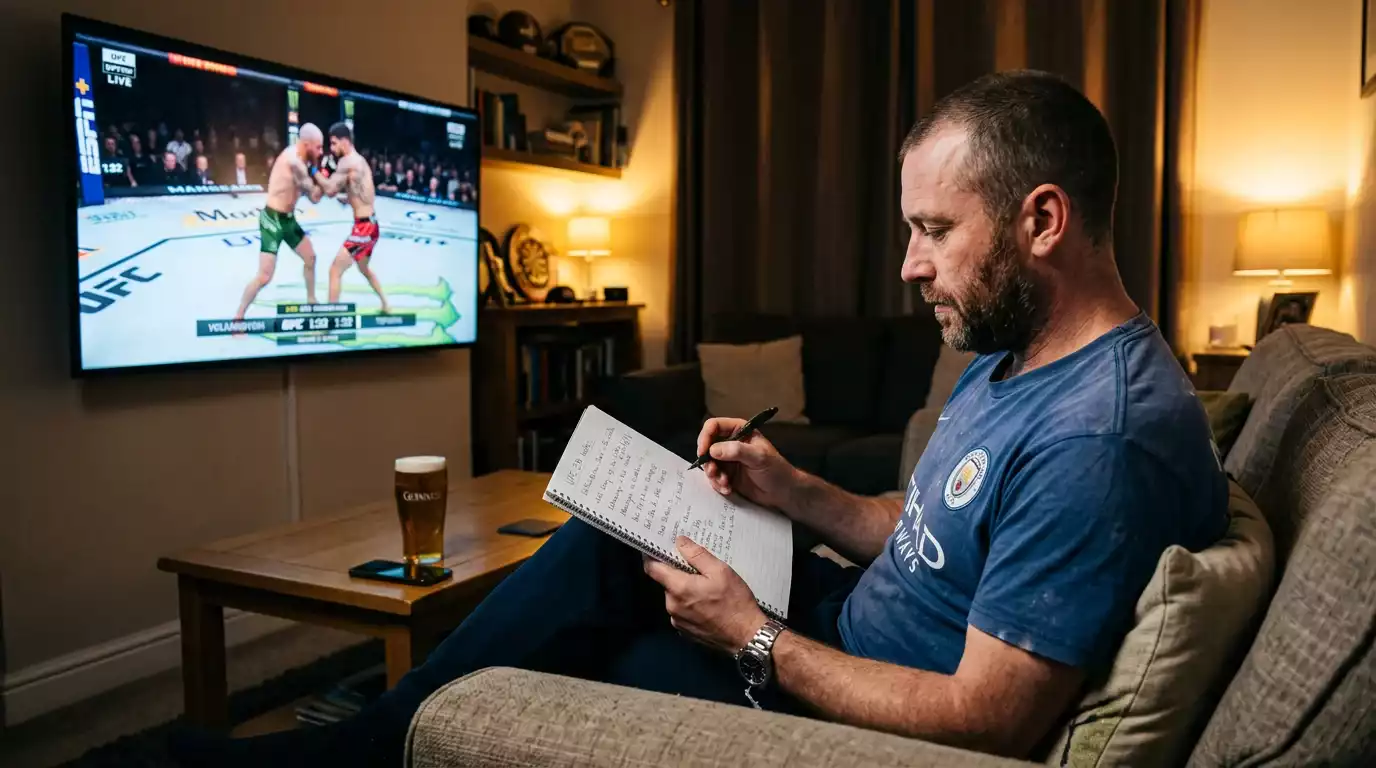
The bankroll framework requires honest tracking. The mental ledger that most punters maintain is consistently biased toward overestimating winning bets and underestimating losing ones. The honest ledger is in writing.
The fields worth tracking per bet are minimal: the fight, the market, the price, the stake as a percentage of the current bankroll, the result, and the brief reasoning that informed the bet. Five lines per bet. Five minutes per card to record them.
The monthly review surfaces patterns the bettor has not wanted to see — method props producing negative returns despite feeling profitable, escalation after specific kinds of losses, overconfidence on UK fighters at home cards. The pattern is the data. The improvement comes from working with the data rather than against it.
The Operator Side of Bankroll
UK sportsbook operators interact with bankroll management in ways the framework has to accommodate. UK Gambling Commission data records that over four per cent of UK gambling accounts have been restricted on commercial grounds, with many of those accounts in profit. A bankroll concentrated entirely on one operator is exposed to this restriction risk. The framework therefore implies spreading exposure across two or three operators, with each holding a portion of the working bankroll, to mitigate the single-operator-restriction scenario.
The mandatory deposit-limit prompts as of October 2025, the financial vulnerability check threshold dropped to 150 pounds per month as of February 2025, and Andrew Rhodes’ framing of the 300 per cent year-on-year increase in criminal cases referred for enforcement all sit alongside the bankroll framework. The tools support the framework rather than constraining it, but only if the bettor configures them deliberately rather than letting the operator defaults shape the betting environment.
Why Discipline Outperforms Reading
The mathematical fact at the centre of UFC bankroll management is that discipline compounds more reliably than reading does. A punter with strong reads and weak discipline averages to break-even or worse across a year because the variance and the escalation patterns consume the edges. A punter with average reads and strong discipline averages to small positive returns across a year because the variance is contained and the escalation is suppressed.
The combination of strong reads and strong discipline is what produces the meaningful returns that some serious UFC bettors achieve over multi-year periods. The combination is rare because most punters develop one side of the equation but not the other. Reading attracts attention. Discipline is the unglamorous half that the conversation rarely addresses.
The UFC calendar produces 40 or more cards per year. The variance across that volume of bouts is high enough that the bettor who has not held to a framework will see the bankroll oscillate wildly regardless of his reading. The bettor who has held to one will see the bankroll trend in the direction his reading deserves.
Two Years of Discipline
The honest answer about how long bankroll discipline takes to produce results is roughly two years of consistent application across the full UFC calendar. Inside that window, variance dominates. After it, the structural edges produce returns that variance can no longer wash out.
The two-year horizon is uncomfortable. Most punters approach UFC betting with a much shorter time frame, looking for results across weeks or months. The shorter time frame is variance-dominated by definition, and the conclusions drawn from short-frame results are usually wrong. The structural reframe is to treat the first two years as the discipline-building phase, during which the bankroll either holds steady or drifts modestly in either direction. The returns phase begins after, when the framework has been internalised and the reads have been refined through the tracking process.
The two-year horizon is the unglamorous truth of serious UFC betting. The marketing implies faster results. The mathematics does not.
For the natural next read, my walkthrough of UFC acca insurance and the small print continues the analysis at the next layer of detail.
What percentage of my bankroll should a single UFC bet represent?
Between one and three per cent of the current bankroll for standard bets, with most bets sized at one and a half per cent and strong-conviction bets sized up to two and a half per cent. Speculative bets including high-variance method props and long-shot futures size at half a per cent or skip entirely. Below one per cent the bets are too small to produce meaningful return across the year. Above three per cent the variance from a difficult run can destabilise the bankroll faster than it can recover, particularly after losing runs that produce six or seven consecutive losses even when the strategy is working as designed.
How should I respond to a losing run on UFC bets?
With contraction rather than escalation. Reduce unit size in line with the smaller bankroll, become more selective about which bets to place, and skip cards where preparation has been incomplete. The intuitive response is escalation — increase unit size to recover faster, take longer-priced positions, place bets on cards where reading is not strong. The escalation pattern destroys bankrolls more reliably than any specific bad bet. The contraction pattern allows the bankroll to recover at a sustainable rate when the reads turn back in your favour, and the mathematical advantage of contraction over escalation across many losing runs is large enough to define long-term profitability.
Prepared by the Betting mma editorial staff.